
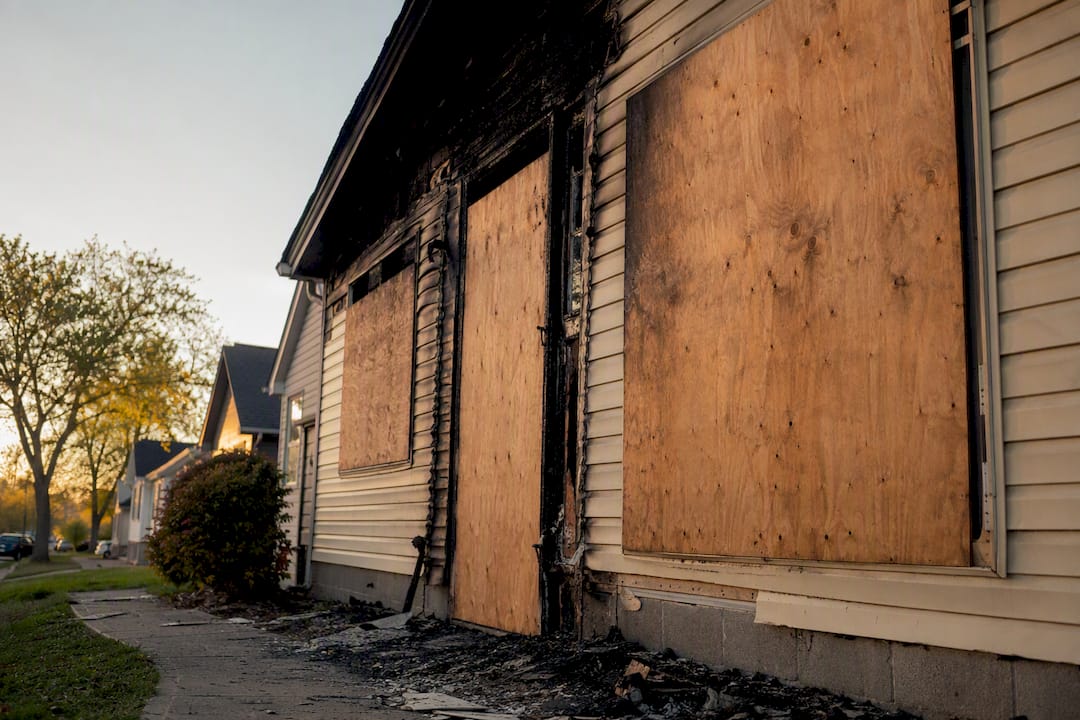
Board up your property as soon as fire responders clear the scene, ideally the same day the fire is out. Every exposed window, door, or roof section left open invites rain, thieves, and animals into a house that’s already hurting. If the structure feels unstable, or you’re staring at a hole where a wall used to be, skip the DIY approach and call a 24/7 emergency restoration crew instead of climbing around on damaged framing.
Before anything goes up, do this:
- Wait for the official all-clear from firefighters before you step inside.
- Photograph every damaged opening, room, and structural issue before you touch a board.
- Board accessible windows and doors first, then assess the roof.
- Call a restoration company immediately if you see structural sag, exposed wiring, or a compromised roof.
TL;DR:
- Boarding up a property should happen within hours of fire responders clearing the scene to prevent rain, theft, and animal entry.
- Exterior screws into structural framing provide better security and wind resistance than nails or trim-mounted fasteners.
- Fire and water damage can weaken structures significantly, requiring professional assessment before any boarding or roof tarp installation.
- Photograph all damage and openings beforehand to support insurance claims, as documentation is crucial for reimbursement.
- Calling a licensed, 24/7 emergency restoration crew ensures proper safety protocols, hazard handling, and efficient, insurable mitigation efforts.
Table of Contents
- Why You Need to Board Up After a Fire
- When Should You Call Professionals Instead of DIY?
- How to Board Up Windows and Doors Step by Step
- How Much Does Emergency Board-Up Cost?
- What Happens After the Boards Go Up?
- What a Professional Restoration Crew Actually Does
- Deciding Which Openings to Board First
- DIY or Professional: How to Decide
- Are There Legal Requirements to Secure a Fire-Damaged Property?
- Safety Gear You Need Before You Start Boarding
- What This Guide Gets Right (and What It Doesn’t)
- Get 24/7 Emergency Board-Up From Infinity Restoration
- Key Takeaways
- Sources
Why You Need to Board Up After a Fire
A fire doesn’t stop causing damage once the flames are out. Every unprotected window or door becomes a funnel for new problems, and most of them are preventable with a sheet of plywood and forty minutes of work.
Water is usually the first threat. Firefighting itself soaks a structure, and an open window during the next rainstorm sends more water into wall cavities and subfloors that are already compromised. The Red Cross recommends coordinating with professionals on cleanup precisely because secondary water damage often exceeds the original fire damage in scope.
Every open window is an invitation. A house with no working locks and gaping holes tells the neighborhood it’s unattended, and looters know exactly what that looks like. Beyond theft, raccoons, birds, and rodents will move into an unsecured structure within days, chewing wiring and nesting in insulation that then has to be torn out and replaced. Soot and smoke residue, meanwhile, keeps etching itself into drywall, fabric, and wood the longer it sits exposed to humidity and temperature swings.
- Rain and firefighting runoff soak framing and insulation through open gaps.
- Unsecured entry points draw thieves and vandals within hours, not days.
- Animals nest in exposed cavities, adding demolition costs later.
- Soot continues corroding metal and staining porous materials the longer it’s exposed.
When Should You Call Professionals Instead of DIY?
Boarding up a single cracked window is a reasonable weekend task. Boarding up a house where the fire department just left a hole in your roof is a different job entirely, and treating it like the first one can get you hurt.
Here’s a quick way to sort it out:
- Confirm the all-clear. Never enter a fire-damaged structure until responders say it’s safe. Floors, ceilings, and stairs can look intact and still be structurally compromised.
- Check for red flags. Sagging ceilings, buckled floors, scorched load-bearing beams, exposed electrical wiring, or a hole in the roof are all reasons to stop and call a licensed crew.
- Consider what’s in the air. Fires involving synthetic materials, insulation, or older construction can leave behind hazardous residues that require protective equipment and containment protocols most homeowners don’t have on hand.
- Weigh the roof separately from the walls. A window is a ladder and a tape measure. A roof is fall risk, tarping technique, and usually a two-person job at minimum.
Professional crews bring more than muscle. They tarp roofs correctly so water sheds instead of pooling, follow hazardous-material protocols when soot or char raises air-quality concerns, and photograph everything in a format insurers actually accept.
Pro Tip: If you’re debating whether a section of your home is safe to approach, treat that hesitation as your answer. Call a professional and let them make the call with the right equipment.
How to Board Up Windows and Doors Step by Step
Once you’ve been cleared to enter and you’re only dealing with accessible windows and doors, not structural collapse, the process is straightforward. Move in this order:
- Photograph everything first. Wide shots of each room, close-ups of damage, and a few shots of the exterior before any boards go up. This protects your insurance claim later.
- Gather your materials. You’ll want 3/4 inch exterior-grade plywood or OSB board, exterior-rated screws (not nails), a drill or impact driver, a tape measure, a circular saw or handsaw, and a heavy-duty tarp if you’re covering roof damage.
- Measure each opening. Measure width and height at multiple points, since fire-damaged frames can warp slightly.
- Cut plywood to size, adding an inch or two of overlap on each side so the board rests against solid framing rather than just the window trim.
- Anchor into the framing, not just the drywall or trim. Screws driven into structural framing hold far better than nails and make the board much harder to pry off, which matters for both security and wind resistance.
- Seal the edges. A bead of exterior sealant or a layer of tarp over the seams keeps rain from working its way behind the board during the next storm.
For roofs, the calculation changes. A small tarp over a single damaged section, laid flat and weighted at the edges, is reasonable if you can do it from a stable ladder without walking on the roof itself. Anything larger, or any roof where you’d need to walk across burned decking, belongs to a professional crew with proper fall protection and tarping experience.
A few things to avoid no matter how capable you feel:
- Don’t stand on any floor or roof section that shows visible fire or water damage.
- Don’t try to remove large structural debris by yourself. Charred framing can be heavier and more unstable than it looks.
- Don’t skip the photos. Once boards go up, the “before” evidence is gone.
Pro Tip: Keep a handful of extra screws in your pocket while boarding. Fire-damaged wood often splits or crumbles around the first screw hole, and you’ll want a backup spot ready without stopping to search for hardware.
How Much Does Emergency Board-Up Cost?
Board-up pricing runs on a few predictable variables: how many openings need covering, how hard they are to reach, and whether you’re calling at 2 PM or 2 AM.
Per-opening costs for a straightforward window typically run $75 to $300 for professional emergency service, with material and labor both factored in. A full job covering multiple windows, a door, and a section of roof climbs into the several-hundred-to-several-thousand-dollar range depending on scope and access.
| Job Type | Typical Cost Range | Main Cost Drivers |
|---|---|---|
| Single window | $75 to $300 | Size, height, accessibility |
| Multiple windows and a door | $75 to $300 | Number of openings, plywood grade |
| Roof tarping plus openings | several-hundred-to-several-thousand-dollar range | Roof pitch, damage size, tarp material |
After-hours emergency calls typically add 20 to 40 percent to the base price, since crews are pulling staff off-shift to respond.
For your insurer, keep this simple:
- Photograph every opening before and after boarding.
- Request an itemized invoice, not a lump-sum receipt.
- Save the provider’s contact information and license number.
Most homeowner policies treat board-up as loss mitigation, which means the cost is generally reimbursable because it prevented further damage, not because it was optional.
What Happens After the Boards Go Up?
Boarding up isn’t the finish line. It’s the pause button that keeps damage from getting worse while the real restoration work gets scheduled.
Once your openings are secure, a restoration crew typically moves through water extraction, soot and smoke cleanup, and structural repair assessment in that order. Boards usually stay in place for as little as a few days to several weeks, depending on how fast permanent windows, doors, or roofing materials can be sourced and installed.
This staged approach matters for your insurance claim too. The photos and invoices from the board-up phase feed directly into the broader claim documentation your adjuster needs, and a clean paper trail from day one tends to move claims faster than a scramble to reconstruct receipts weeks later.
- Board-up happens same day, ideally within hours of clearance.
- Water extraction and soot cleanup typically follow within the first week.
- Structural repairs get scheduled once the scope is fully assessed.
- Boards come down only when permanent replacements are ready to install.
The full sequence, from initial mitigation through fire damage restoration, runs on its own timeline depending on the extent of the fire.
What a Professional Restoration Crew Actually Does
Hiring a licensed crew changes what happens in the first hour, not just the first day. A professional team arrives with the tools, protocols, and paperwork that turn a chaotic scene into a documented, insurable process.
Infinityrestoration operates as a 24/7 emergency responder in the Orlando area, which means a call at 3 AM gets the same response speed as one at 3 PM. Crews conduct a safety-first structural assessment before anyone starts boarding, photograph every opening and damage point for insurance purposes, and bring a Florida Licensed Mold Assessor into the plan when moisture intrusion raises the risk of secondary mold growth.
A house that sits open overnight after a fire is exposed to weather, theft, and pests in ways that compound the original damage. Fast, documented board-up protects both the structure and the claim that follows.
- Rapid arrival to minimize the window of exposure after a fire.
- Photo documentation formatted for insurance adjusters, not just personal records.
- Moisture mapping to catch water intrusion before it becomes hidden mold.
- Family-owned operation with a track record of five-star local reviews.
Deciding Which Openings to Board First
Not every opening carries the same risk, and boarding in the wrong order wastes daylight you don’t have. Start with a walk-around, not a room-by-room checklist.
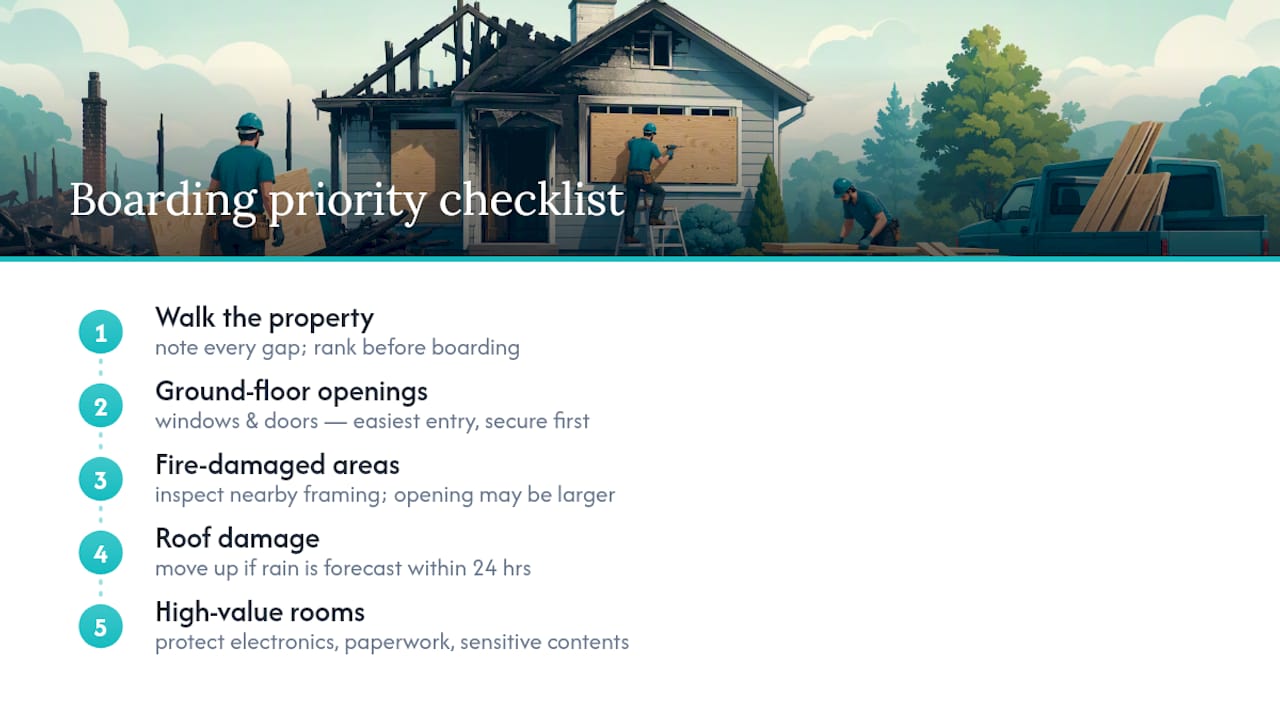
Ground-floor windows and doors come first. They’re the easiest entry points for both weather and people, and they’re usually the fastest to secure. A shattered ground-floor window left open for even one afternoon is an open invitation, while a cracked second-story window facing an interior courtyard can reasonably wait an hour longer.
Next, look at where the fire actually did its damage. A kitchen fire that blew out a single window needs one board. A fire that burned through a roofline or a wall section needs a much broader assessment, since the “opening” might be larger than it first appears once you account for weakened framing around the visible hole.
Roof damage gets prioritized based on weather, not convenience. If rain is forecast within 24 hours, a compromised roof section jumps to the top of the list regardless of how small it looks from the ground, because water intrusion through a roof affects ceilings, insulation, and everything below it on the way down.
Finally, factor in which rooms hold the most value or the most sensitive contents. A den full of electronics or paperwork behind a broken sliding door deserves faster attention than a garage window, even if the garage window is technically the bigger hole. Walk the property once, note every gap, and rank them by weather exposure, ease of entry, and what’s sitting behind each one before you cut a single board.
DIY or Professional: How to Decide
The honest answer depends less on confidence and more on three concrete factors: what tools you already own, what the damage actually looks like, and how much physical risk you’re willing to accept.
If you own a drill, a saw, and a ladder, and you’re only dealing with one or two ground-floor windows with no structural involvement, DIY boarding is a reasonable few hours of work. The materials cost less than a professional call-out, and the process described earlier in this guide covers the full sequence.
The equation flips once you’re missing tools, facing more than a couple of openings, or looking at anything above the first floor. Cutting plywood accurately without a circular saw is slow and imprecise. Working on a ladder against a structure that may have weakened framing raises the physical risk considerably, and most homeowners don’t own the fall protection or roof-tarping gear a professional crew brings as standard equipment.
There’s also a time factor that’s easy to underestimate. A professional crew can often complete a whole-house board-up in the time it takes one person to finish a single window, which matters when rain is rolling in or darkness is an hour away. If you’re weighing your own labor against a same-day professional response, factor in not just the dollar cost but the hours of daylight and physical effort you’d spend doing it solo, especially with fire-damaged, potentially slippery, or splintered materials involved.
Are There Legal Requirements to Secure a Fire-Damaged Property?
Most municipalities in the United States require property owners to secure a fire-damaged structure against unauthorized entry, though the specific ordinance language and enforcement vary by city and county. Many jurisdictions classify an unsecured, fire-damaged building as a public nuisance or safety hazard, which can trigger code enforcement action, fines, or in some cases a city-ordered board-up performed at the owner’s expense.
Insurance policies add a practical layer on top of any local ordinance. Most homeowner policies include a “duty to mitigate” clause, meaning the policyholder is contractually expected to take reasonable steps, like boarding up openings, to prevent further damage after a covered loss. Failing to do so can give an insurer grounds to reduce or dispute a claim for damage that occurred after the fire but before mitigation happened.
Check with your local building or code enforcement office for the specific timeline your jurisdiction expects, since some cities specify a window (often 24 to 72 hours) for securing a vacant or damaged structure. If you’re unsure whether your city has a specific ordinance, a call to your city’s code enforcement line usually gets a fast answer, and a licensed restoration company operating in your area will typically already know the local requirements for the properties they service.
Safety Gear You Need Before You Start Boarding
Fire-damaged structures are not a normal work site, and treating the boarding process like a routine home-improvement project is how people get hurt.
At minimum, wear closed-toe boots with a solid sole, since debris, nails, and broken glass are common on fire scenes. Heavy work gloves protect your hands from splintered wood and sharp metal edges that are easy to miss in low light or through soot coverage. A N95 or P100 respirator mask matters more than people expect, since smoke residue and ash particles remain airborne and settle into surfaces long after the fire is out, and breathing them in during physical work is a real irritant risk.
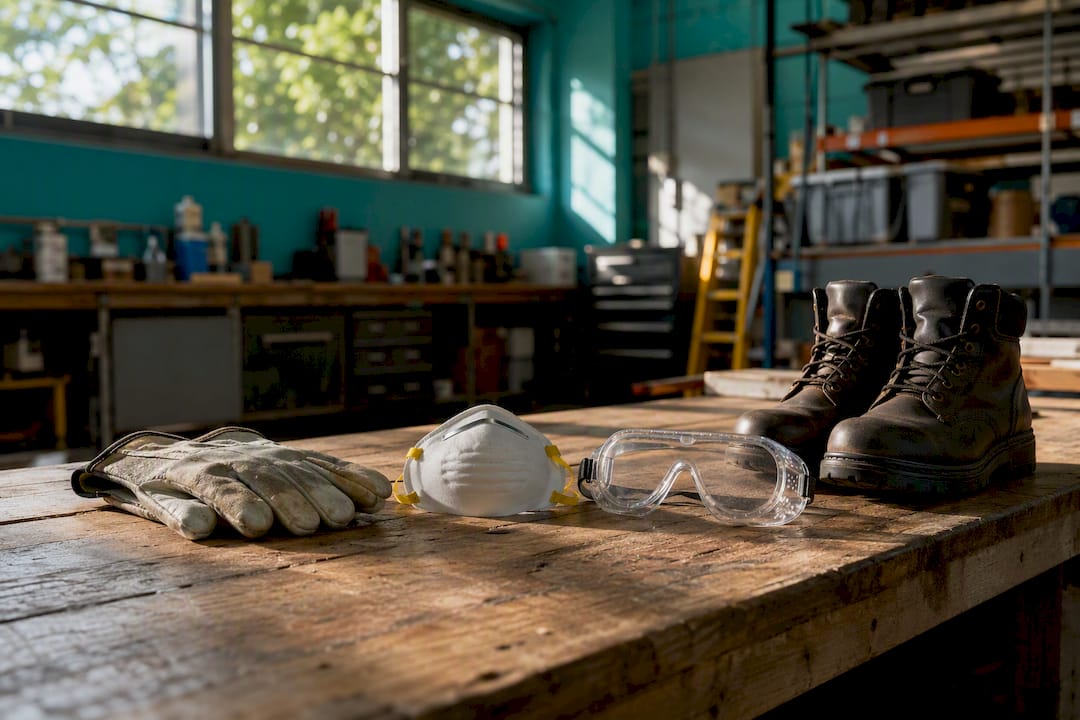
Eye protection is non-negotiable if you’re cutting plywood or drilling into damaged framing, since fire-weakened wood tends to splinter unpredictably. If you’re working near any area with visible char on structural members, treat the surrounding ash as contaminated and avoid stirring it up more than necessary. A hard hat is worth wearing if you’re working anywhere near a compromised ceiling or roofline, even one that looks stable from the ground.
Skip any task that requires standing on a roof, a damaged floor, or scaffolding you’re not confident in. That’s exactly the threshold where a licensed crew’s equipment and training start earning their cost.
What This Guide Gets Right (and What It Doesn’t)
Most advice about post-fire board-up treats it as a pure DIY task or skips straight to “call a professional” without explaining why one path makes sense over the other. Neither extreme serves homeowners well. The honest answer is that boarding a single ground-floor window and boarding a house with roof damage are two different risk categories, and conflating them leads people to either overpay for a simple job or underestimate a dangerous one.
What’s underrated in most guides is the insurance angle. Homeowners fixate on the physical act of boarding and forget that the photos taken beforehand often matter more to the claim than the boards themselves. Skip that step, and you’re negotiating a claim with weaker evidence than you needed.
What’s overrated is confidence. A homeowner who’s handy with tools can absolutely board a window. That same confidence, applied to a scorched roofline or a wall with exposed wiring, is how a manageable fire turns into a second emergency. Prioritize the photos first, the easy openings second, and a phone call to a licensed crew the moment anything looks structurally uncertain.
*— Nate
Get 24/7 Emergency Board-Up From Infinity Restoration
If you’re standing outside a fire-damaged home right now trying to decide between a hardware store run and a phone call, Infinityrestoration is built for exactly this moment. Unlike a general handyman or a same-day plywood delivery service, Infinityrestoration pairs emergency board-up with a full restoration team, so the same crew that secures your windows tonight can also run the moisture mapping and mold assessment your claim will likely need next week.
Every job starts with a rapid, 24/7 emergency response that includes a safety-first structural check, photo documentation formatted for your insurer, and licensed specialists on staff, including a Florida Licensed Mold Assessor, for anything beyond basic boarding. If your Orlando-area property needs securing right now, reach out through the fire damage restoration page to get a rapid-response crew on the way and a documented plan started before the next rainstorm rolls in.
Key Takeaways
Boarding up a fire-damaged property within hours of clearance, backed by photo documentation, is the single most effective step for limiting further loss and supporting an insurance claim.
| Point | Details |
|---|---|
| Act the same day | Board openings as soon as responders clear the scene, before weather or theft adds new damage. |
| Photograph before boarding | Document every room and opening first, since insurers rely on before-and-after evidence. |
| Know your limits | Structural instability, roof holes, or exposed wiring mean it’s time to call a licensed crew. |
| Anchor into framing | Use exterior screws into structural framing, not nails into trim, for real security. |
| Call Infinityrestoration for full coverage | Infinityrestoration offers 24/7 board-up plus documentation and licensed mold assessment for Orlando-area fire damage. |
Sources
- U.S. Fire Administration — Fire and Life Safety After a Fire (FA-46)
- American Red Cross — Cleaning up after a fire
- Homewyse — Cost to board up window
- CurrentCost — Emergency board-up cost: price range and factors for U.S. homes
- RestorePro — Emergency board-up services after fire damage: what to expect