
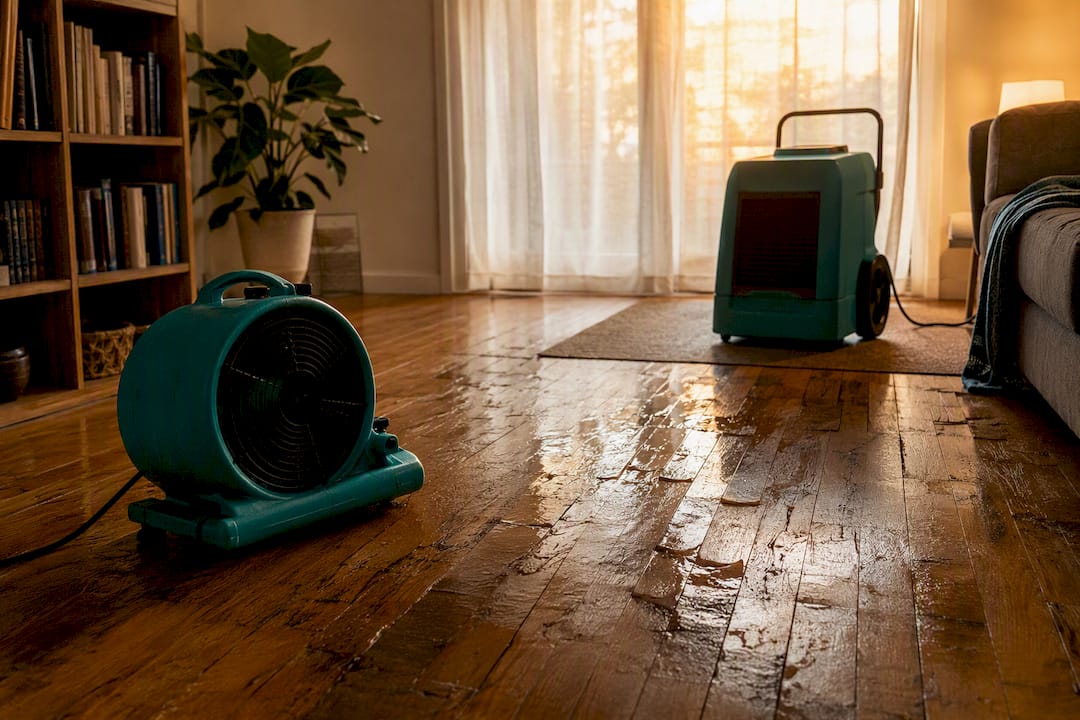
Most solid hardwood floors can be saved if you catch the water within the first day or two and dry them the right way. Engineered floors, floors that sat under standing water for days, or anything touched by contaminated water are a different story. Your first move isn’t a mop. It’s cutting off the water source and pulling standing water off the boards before it soaks further into the wood.
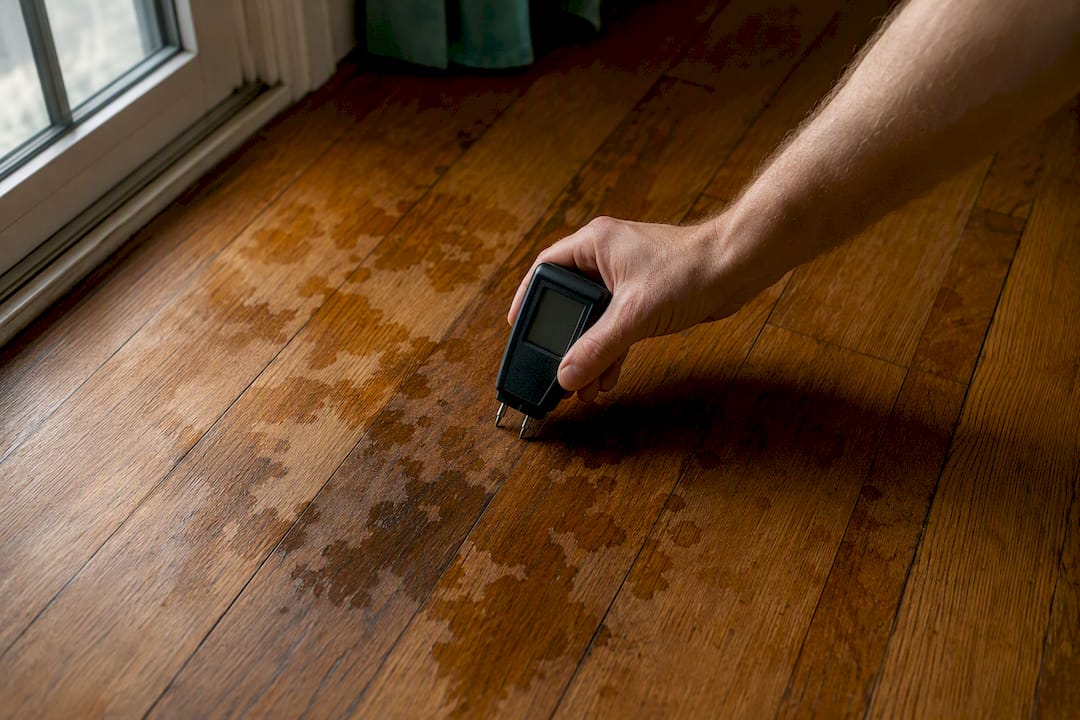
Professionals don’t guess at “dry.” They measure it. A moisture meter reading compared against an unaffected area of your own floor, following IICRC S500 drying standards, tells you whether the wood is actually stable or just looks that way.
- Shut off the water source immediately, then extract standing water with towels or a wet/dry vac.
- Get air moving and start pulling humidity down within hours, not days.
- Don’t trust your eyes. Boards that look fine can still be holding onto serious moisture.
Boards that look completely dry can still retain 18% to 25% moisture while most U.S. interiors need hardwood at 6% to 9% to be considered stable.
Key Takeaways
Solid hardwood floors survive water damage most often when the source is stopped fast, moisture is verified with a calibrated meter rather than a glance, and drying follows controlled IICRC S500 targets instead of maximum speed.
| Point | Details |
|---|---|
| Act within hours, not days | Stop the water source and extract standing water immediately to limit absorption into the boards. |
| Trust meters, not eyes | Boards can hold 18% to 25% moisture while looking completely dry to the naked eye. |
| Watch the damage sequence | Cupping is often reversible; crowning, buckling, and delamination usually mean replacement. |
| Budget for refinishing | Most floors that survive drying still need a full sand and refinish, not a quick patch. |
| Call in professionals early | Infinity Restoration offers moisture mapping, mold testing, and insurance documentation for Orlando-area water damage. |
Table of Contents
- What To Do in the First 24 Hours After Hardwood Floor Water Damage
- How Do Professionals Dry Hardwood Floors After Water Damage?
- Can Water-Damaged Hardwood Be Saved or Does It Need Replacing?
- What Happens After the Floor Is Dry: Refinish or Replace?
- How Long Does It Take to Dry and Repair a Hardwood Floor?
- How Can You Prevent Future Hardwood Floor Water Damage?
- When Should You Call a Professional for Water-Damaged Hardwood?
- Frequently Asked Questions
- Sources
What To Do in the First 24 Hours After Hardwood Floor Water Damage
The first day decides a lot. Every hour water sits on or in your hardwood, it pushes further into the seams and toward the subfloor, which is where small problems turn into replacement jobs.
- Cut the water source. If it’s a supply line or appliance, shut off the valve or main. If water is anywhere near outlets or a panel, kill the power to that area before you step in.
- Remove standing water fast with a wet/dry vac, mops, or old towels. Don’t wait for it to evaporate on its own.
- Move furniture, rugs, and anything absorbent off the wet area so it stops trapping moisture against the boards.
- Manage airflow based on your climate. Open windows if the outside air is dry; keep them shut and run a dehumidifier if it’s humid outside.
- Photograph and video everything before you touch it, and note the date and time. That record matters more than you think once an insurance adjuster gets involved.
- Skip the space heater. Cranking up heat pulls moisture out of the top of the board faster than the bottom, and that mismatch is exactly what causes crowning later.
- Don’t wait to see “if it dries on its own” before calling for help if more than a small area is affected.
Pro Tip: Resist the urge to blast a fan on high and call it done after a few hours. Fast surface drying without airflow underneath just traps moisture in the middle of the board, and that’s the mess you can’t see until the floor starts crowning weeks later.
How Do Professionals Dry Hardwood Floors After Water Damage?
Professional drying isn’t about speed. It’s about equalizing moisture across the board so the wood doesn’t warp on its way back to normal. Dry the surface too fast while the core is still wet, and a cupped board (edges higher than the center) can flip into crowning (center higher than the edges), which often can’t be sanded out.
Controlled drying balances ambient humidity instead of forcing rapid evaporation, using equipment matched to the severity of the loss:
- Extraction mats to pull remaining surface water out of the seams
- Commercial air movers positioned to move air across and under the flooring
- LGR or desiccant dehumidifiers to control ambient humidity in the room
- Negative-pressure floor-drying mat systems that draw moisture up through the wood from below
Monitoring is what separates a guess from a verified dry floor. Technicians use calibrated pin or pinless meters, log readings daily, and compare them against a reference area of unaffected flooring in the same room.
- Take baseline readings on day one across the wet zone and a dry reference spot.
- Set up equipment and recheck readings every 24 hours.
- Stop drying only when readings match the reference area, not when the surface “feels” dry.
Pro Tip: If a technician pulls equipment after just a day or two without giving you a moisture log, ask for one. A real drying job leaves a paper trail of numbers, not just a verbal “it’s good now.”
Can Water-Damaged Hardwood Be Saved or Does It Need Replacing?
Floor type is the first thing to check, before you even think about equipment. Solid hardwood over a wood subfloor is usually your best case. Engineered hardwood depends entirely on the thickness of the wear layer, and laminate is essentially a lost cause once water gets under the surface.
Damage tends to follow a predictable path: surface wetting, then cupping, then crowning, then buckling or delamination. Catch it at cupping and you’re likely fine. Let it progress to buckling and you’re probably replacing boards.
- Cupping (edges curl up): usually reversible with proper controlled drying.
- Crowning (center bulges up): often means the damage is already past the point of easy recovery.
- Delamination, heavy staining, or visible mold growth: replacement territory, no question.
- A soft or spongy feel underfoot: sign the subfloor itself took on water, which changes the whole scope of the job.
| Floor Type | Construction | Likely Outcome After Water Exposure |
|---|---|---|
| Solid hardwood, wood subfloor | 3/4-inch solid wood planks | Often salvageable with controlled drying and refinishing |
| Engineered hardwood, thick wear layer | Plywood core, veneer over 2mm | Sometimes salvageable, refinishing options limited |
| Engineered hardwood, thin wear layer | Veneer around 3mm or less | Frequently not salvageable once wet |
| Solid hardwood over concrete slab | Glued or nailed to concrete | Higher replacement risk due to slab moisture retention |
| Laminate flooring | Fiberboard core with printed layer | Almost always requires replacement |
What Happens After the Floor Is Dry: Refinish or Replace?
Getting the moisture content down doesn’t mean the job is finished. It means you can finally start the actual repair.
- Confirm the moisture reading has held steady for several consecutive days, not just hit target once.
- Let the wood acclimate to normal room conditions before any sanding begins.
- Sand and refinish if the boards are structurally sound and the finish layer allows it.
- Replace individual boards where cupping never fully reversed, matching species, width, and stain as closely as possible.
- Most floors that make it through drying still need a full sand and refinish, not just a spot touch-up.
- Board replacement in the middle of a room means blending new wood into old, which is a job worth handing to someone who’s done it before.
- Transitions between replaced sections and original flooring are where amateur repairs usually show.
How Long Does It Take to Dry and Repair a Hardwood Floor?
A surface spill wiped up within the hour might need nothing more than a fan overnight. A localized leak that sat for a day typically needs professional equipment running for several days. A real flooding event, water sitting for 24 hours or more across a large area, is a longer job with more variables.
Most professional drying projects wrap up in 5 to 14 days, depending on severity and equipment. After that, plan on another 2 to 6 weeks of acclimation before sanding and refinishing starts.
Costs swing widely based on a handful of factors:
- Total square footage affected and how far water traveled under the flooring
- Whether the subfloor also needs drying or replacement
- Mold remediation, if the water sat long enough for growth to start
- Equipment rental versus hiring a restoration company to manage the whole process
- Refinishing costs once the floor is stable, which vary by wood species and finish type
Call your insurer early. Photograph everything before cleanup starts, keep every moisture log and invoice, and note whether the water source was sudden (usually covered) versus gradual (often disputed). That documentation is what turns a claim into a paid claim.
How Can You Prevent Future Hardwood Floor Water Damage?
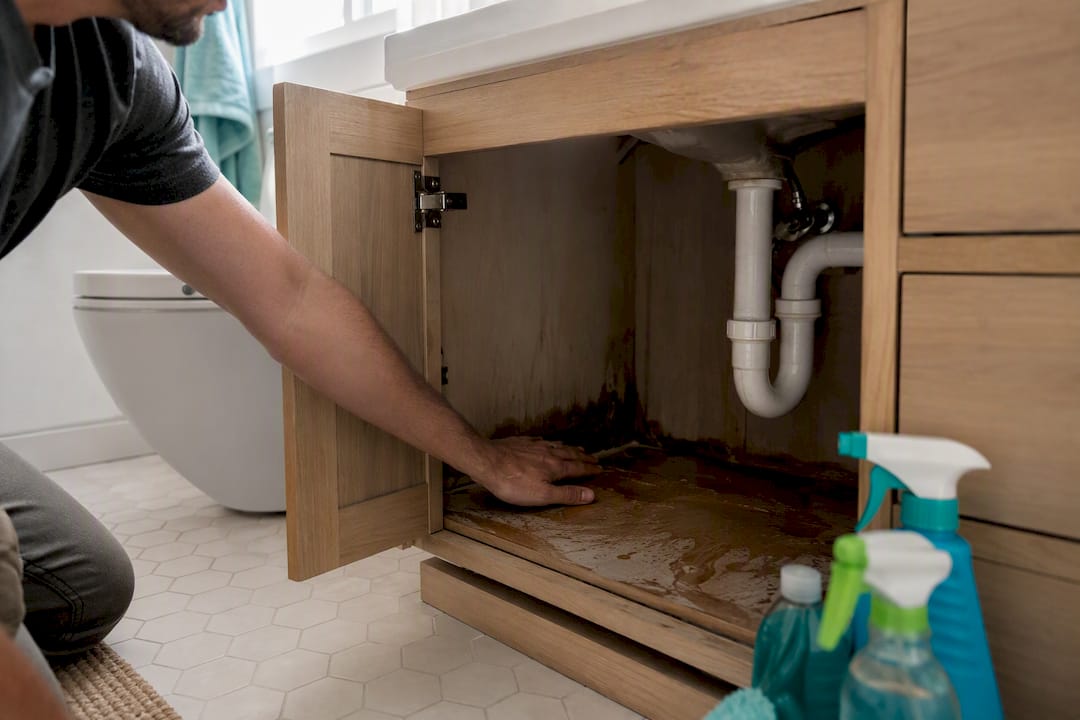
Most water damage claims trace back to something that could’ve been caught weeks earlier. A slow drip under a sink or a failing supply line doesn’t announce itself until the floor is already cupping.
- Keep indoor humidity in a stable range using a humidifier in dry months and a dehumidifier during Florida’s humid season.
- Wipe up spills immediately rather than letting them sit, even for “just a few minutes.”
- Use mats or trays at high-risk zones: under the fridge, near the dishwasher, by exterior doors.
- Inspect appliance hoses, supply lines, and toilet connections every few months for early signs of wear.
- Check and refresh caulking around tubs, showers, and sinks before it starts to crack.
Install leak-detection sensors near your water heater, washing machine, and under sinks. They run on batteries, cost less than a service call, and catch slow leaks long before you’d notice a stain on the floor.
Pro Tip: Set a phone reminder every six months to physically check under every sink in the house. Most slow leaks get discovered by smell or a warped cabinet floor, weeks after the hardwood outside that cabinet has already started absorbing moisture.
When Should You Call a Professional for Water-Damaged Hardwood?
Some situations are DIY territory. Others need a professional the same day.
Call immediately if any of these apply:
- Water came from a contaminated source, a sewer backup, or floodwater from outside.
- Standing water sat for more than 24 to 72 hours before you could address it.
- You notice a musty smell, visible mold, or the floor feels spongy or soft underfoot.
- Moisture readings plateau instead of dropping, even with fans and a dehumidifier running.
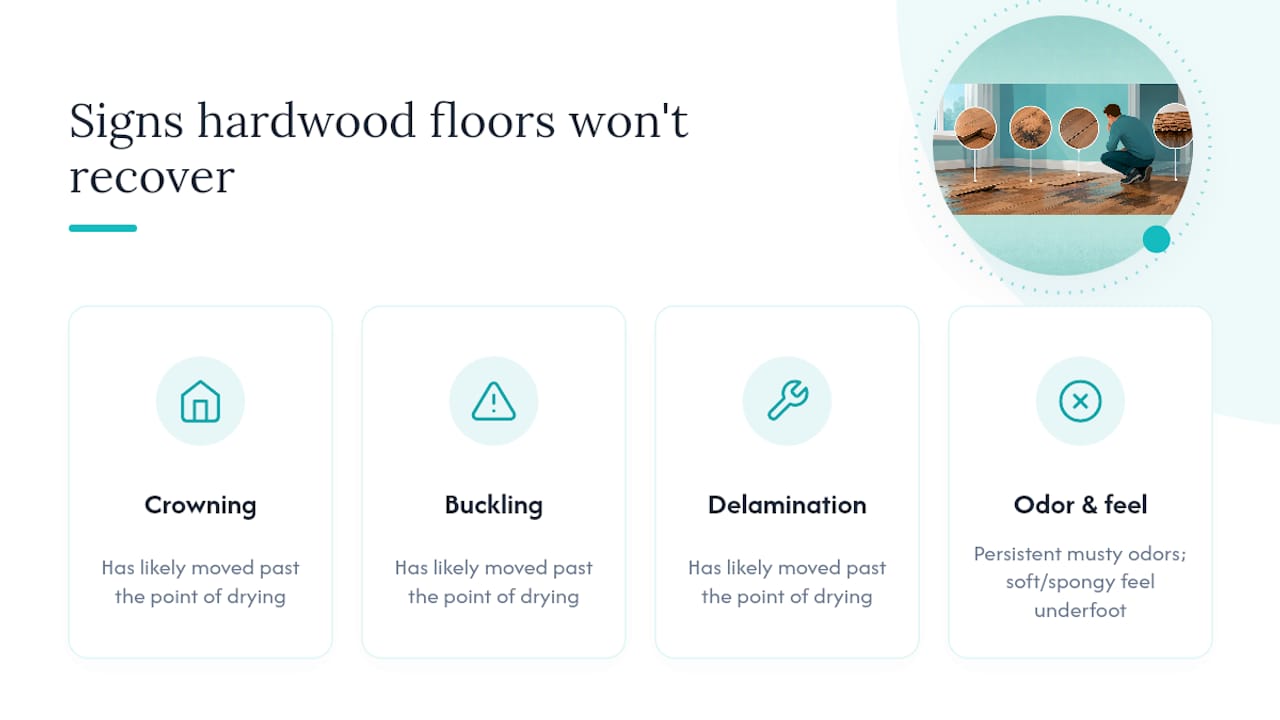
- You see crowning, buckling, or boards separating from the subfloor.
A licensed restoration contractor brings tools and documentation most homeowners don’t have access to:
- Moisture mapping across the whole affected area, not just spot checks
- Negative-pressure mat drying for water trapped between the flooring and subfloor
- Subfloor assessment, since a wet floor is only half the problem if the structure underneath is compromised
- Mold testing and remediation handled by a licensed mold assessor when conditions call for it
- Full documentation: daily drying logs, before-and-after photos, and a written scope of work you can hand straight to your insurer
Ask for all of that paperwork before you sign anything. A contractor who can’t produce a moisture log probably isn’t running a real drying protocol.
An honest take on what actually saves floors
Most homeowners lose their floor not because the water was too much, but because they waited a day to see if it would “dry on its own.” Speed and a real moisture meter save more hardwood than any amount of fancy equipment does. Assume refinishing is coming either way.
Get Emergency Help for Water-Damaged Hardwood Floors
You’ve got options when hardwood floors take on water. You could rent a dehumidifier and hope for the best, or hand the whole problem to a team that measures instead of guesses. Infinity Restoration runs 24/7 emergency response across the Orlando area, with moisture mapping and calibrated readings that tell you exactly what’s salvageable before a single board gets sanded.

That same team includes a Florida Licensed Mold Assessor on staff, so if water sat long enough to raise mold risk, testing happens without bringing in a second company. Every job comes with real-time documentation, drying logs, and before/after photos built for your insurance claim, not just for the file cabinet. If your hardwood floor is wet right now, call Infinity Restoration for an emergency assessment before the damage moves past the point of saving it.
Frequently Asked Questions
Can hardwood floors be saved after water damage?
Yes, in many cases, especially with solid hardwood over a wood subfloor where drying starts within the first day or two and moisture is verified with a meter rather than a visual check.
How long does it take to dry a water-damaged hardwood floor?
Professional drying typically takes 5 to 14 days depending on severity, with an additional 2 to 6 weeks of acclimation before refinishing.
What are the signs my hardwood floor won’t recover from water damage?
Crowning, buckling, delamination, persistent musty odors, and a soft or spongy feel underfoot are all signs the floor has likely moved past the point of drying alone fixing it.
Does homeowners insurance cover hardwood floor water damage?
Sudden, accidental water damage is often covered, while gradual leaks may be disputed. Photograph everything immediately and keep moisture logs to support your claim.
Should I try to dry a water-damaged floor myself?
For a small, quickly cleaned spill, fans and a dehumidifier may be enough. For anything larger, contaminated water, or water that sat overnight, a professional with moisture mapping equipment gives you a far more reliable outcome.
Sources
- Hardwood Floor Drying: Complete Guide for Homeowners – D and G Flooring
- How To Dry Hardwood Floors in Water Mitigation (R&R Magazine)