

If water is entering your home, stop the flow if it’s safe to do so, get everyone away from the affected area, and call a 24/7 certified restoration crew immediately. Mold can start colonizing wet drywall and framing within 24 to 48 hours, so every hour without extraction adds to the repair bill. Specialized 24/7 restoration responders exist for exactly this window.
TL;DR:
- Professional restoration crews typically arrive within 60 to 90 minutes, drastically reducing mold risk and repair costs by preventing secondary damage.
- A thorough assessment, moisture mapping, and documentation are crucial first steps to guide effective drying and insurance claims, not just quick water removal.
- Using the right equipment like submersible pumps, truck-mounted extractors, and moisture meters ensures efficient water extraction and checks for hidden moisture.
- Prompt response limits mold growth; delays beyond 48 hours significantly increase the likelihood of structural damage, mold, and more extensive repairs.
- Verifying a company’s response time with guaranteed ETAs, certified technicians, and real-time documentation filters out unreliable providers and simplifies insurance processes.
Table of Contents
- Your First-Hour Water Damage Checklist
- What Happens When a Restoration Crew Arrives
- Why Every Hour Without Extraction Costs More
- The Equipment Behind a Fast Drying Job
- How Do You Verify a Company’s Fast Response Is Real?
- Insurance Documentation and What the Timeline Looks Like
- A Real-World Look at Fast Response Done Right
- Why Verified Speed Beats a Cheap Quick Fix
- Get Help From Infinity Restoration Right Now
- Sources
Your First-Hour Water Damage Checklist
The first 60 minutes after you discover flooding decide how much of your home you save. Before anyone touches a mop, run through a short mental triage: is this safe to be near, and can I stop it at the source?
Start here, in this order:
- Cut the power to any room with standing water, but only at the breaker panel, and never if you’d have to walk through water to reach it.
- Shut off the main water valve. It’s usually near the water meter, in a basement, crawl space, or a utility closet on an exterior wall. If you don’t know where yours is, find it today, not during an emergency.
- Check for gas odors and leave immediately if you smell anything unusual, calling your utility company from outside.
- Move valuables and electronics off the floor and out of the room, prioritizing documents, photos, and anything electrical.
- Contain what you can with towels, a shop vacuum, or sandbags at doorways, but don’t wade into water that’s more than ankle deep or that came from a sewer backup.
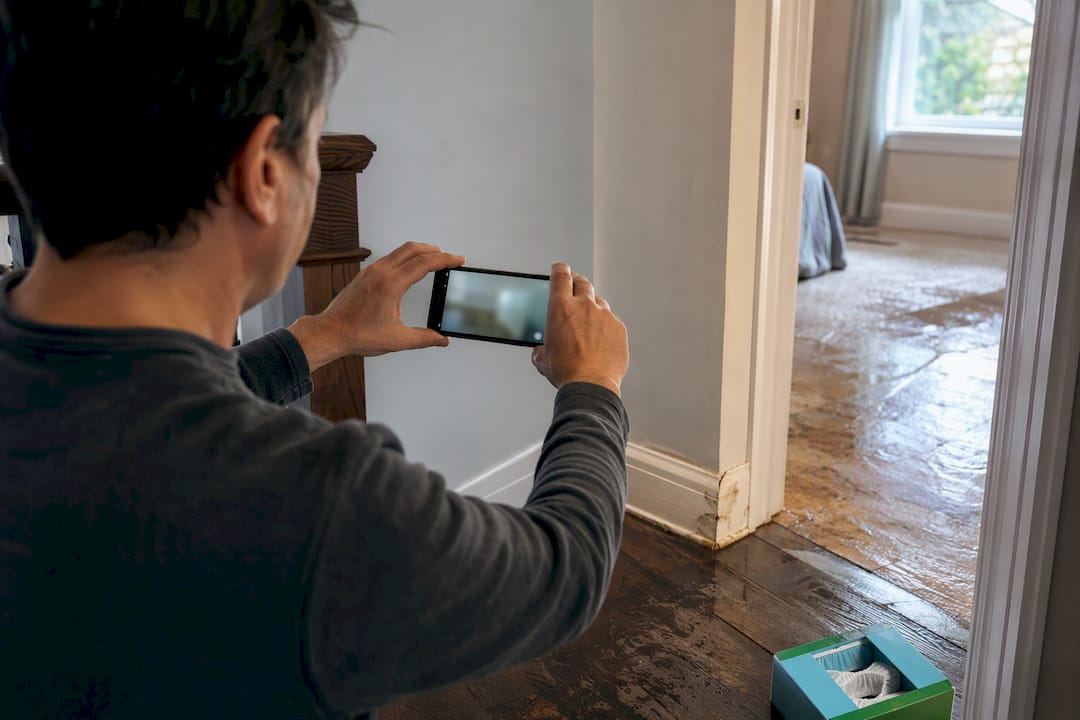
- Photograph everything before you move a single item. Timestamp the source of the water, the affected rooms, and the waterline on walls and furniture.
- Call a 24/7 restoration line and have the time the water started, the suspected source, and your address ready. Dispatchers use this to route the right size crew.
Some situations aren’t DIY territory at all. Standing water that’s touched a sewer line, floodwater from outside, or any water near an outlet or panel needs a professional before you do anything beyond getting people clear. The same goes for sagging ceilings or floors that feel soft underfoot. If a burst pipe caused the flood, shutting off the main and photographing the damage before insurers arrive protects your claim later.
Pro Tip: Take a short video walking through every affected room before you move anything. A video captures water depth, damaged contents, and room layout faster than a dozen photos, and insurance adjusters like the context.
What Happens When a Restoration Crew Arrives
A properly trained crew doesn’t start pumping water the second they walk in. They assess first, because the wrong move on an unstable floor or a live electrical hazard creates a second emergency.
Expect the visit to follow a fairly consistent sequence:
- Safety and source check. Technicians confirm the water is off, test for electrical hazards, and make a temporary plumbing repair if the source is still active.
- Bulk extraction. Submersible pumps handle standing water over an inch or two deep, while truck-mounted extractors pull moisture out of carpet, pad, and subfloor. This is the step that matters most: immediate extraction followed by drying equipment is the standard workflow for stopping secondary damage before it starts.
- Removal of unsalvageable materials. Soaked insulation, ruined carpet pad, and drywall that’s wicked water past the flood line usually come out at this stage, not later.
- Air movers and dehumidifiers go in immediately, positioned to create airflow across wet surfaces rather than just blowing air around the room.
- Moisture mapping and documentation. Crews log moisture readings at multiple points, photograph the scope of damage, and start building the written estimate insurers will need.
A good crew also talks to you before they touch anything major. You should know what’s being removed, roughly what the drying plan looks like, and how the visit connects to your insurance claim before they leave that first day.
Why Every Hour Without Extraction Costs More
Water damage follows a predictable clock, and it’s not a gentle one. In the first few hours, damage is mostly cosmetic and confined to the materials that got wet directly. By the 24 to 48 hour mark, mold spores that were dormant start finding the moisture and organic material they need to colonize drywall paper, wood framing, and fabric. Past 48 to 72 hours, you’re often looking at structural softening in subfloors, warped hardwood, and drywall that has to come out rather than dry out.
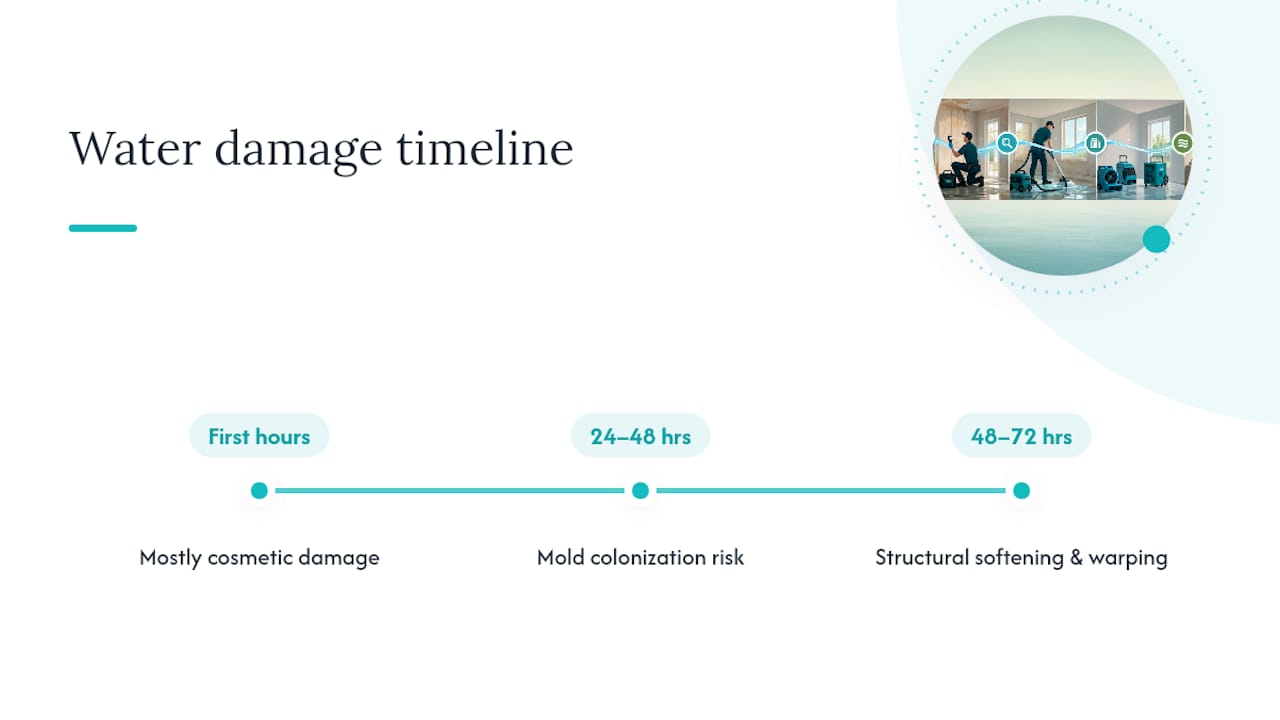
Regional restoration providers report that a prompt on-site response substantially reduces total restoration scope compared to mitigation that starts a day or more later, according to emergency response data from Houston-area restoration crews.
That gap compounds fast. A wet carpet pad pulled and replaced on day one might cost a few hundred dollars. The same pad left wet for three days can mean torn-out subfloor, mold remediation, and a longer reconstruction timeline. If you’re in Central Florida, the math gets worse: warm, humid air is close to ideal for mold growth, so the same spill that might take four days to turn into a mold problem up north can turn in half that time here.
This is the practical argument for a guaranteed ETA. A crew that shows up in 60 to 90 minutes catches the job while it’s still small. A crew that shows up tomorrow is often catching a much bigger, much more expensive job.
The Equipment Behind a Fast Drying Job
Speed on paper means nothing without the right gear on the truck. Watching what equipment actually shows up tells you a lot about whether a crew can back up its promises.
For bulk water removal, look for:
- Submersible pumps for standing water deeper than an inch or two.
- Truck-mounted extractors that pull far more volume per minute than a portable shop vacuum.
- High-capacity vacuums for carpet, pad, and upholstered furniture.
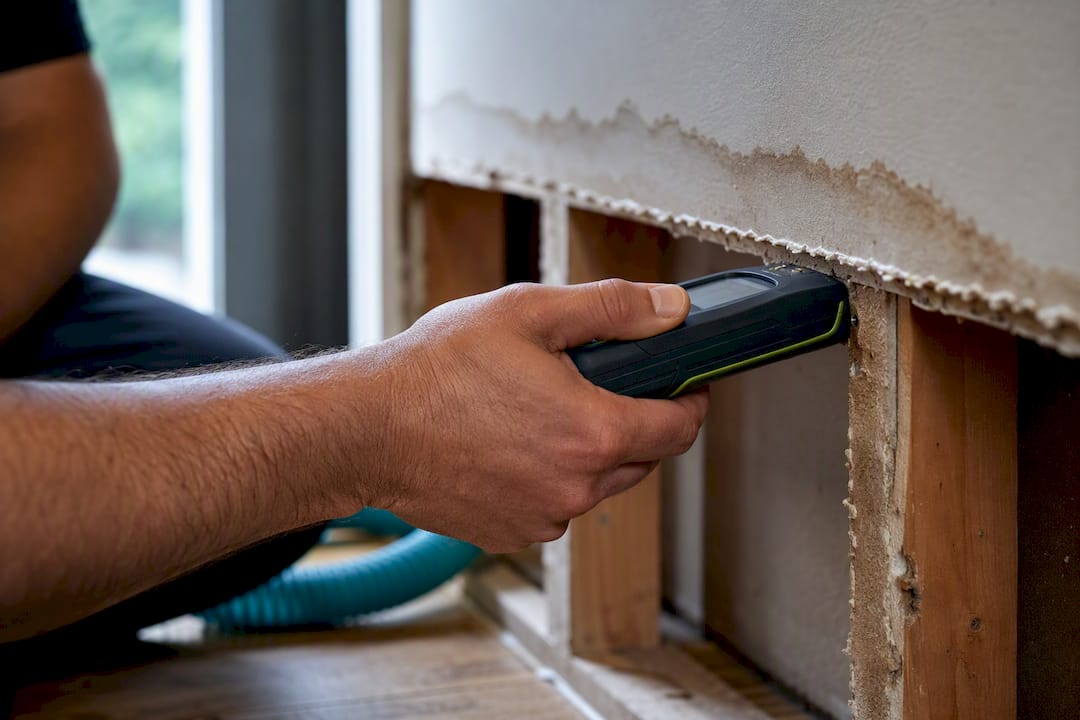
Diagnostic tools matter just as much as the pumps and fans. Moisture meters and thermal imaging let technicians find water that’s traveled inside walls or under flooring, invisible to the eye but very real to a moisture reading. Humidity logging over the following days tracks whether the drying plan is actually working, not just whether the room feels dry to the touch.
Sometimes reaching hidden moisture means controlled demolition: cutting a section of drywall a foot above the visible waterline, or pulling flooring that’s trapped water underneath. Done correctly, this isn’t overkill. It’s the difference between a house that’s actually dry in five days and one that looks dry but grows mold behind the walls three weeks later.
Pro Tip: Ask to see the actual moisture readings, not just be told the room “reads dry.” A number on a meter, logged with a date and location, is worth far more than a verbal assurance.
How Do You Verify a Company’s Fast Response Is Real?
Every restoration company claims to be fast. Few can prove it on the phone before they ever show up. The questions you ask during that first call separate the crews that mean it from the ones reading a script.
Ask these directly:
- “What’s your guaranteed on-site ETA, and who’s dispatched right now?” A real 24/7 operation can name a timeframe and often a crew, not just say “soon.”
- “Are your technicians IICRC certified?” This is the industry-standard credential for water damage restoration, and certified technicians and IICRC-compliant processes are the baseline trust signal across the industry.
- “Do you have a licensed mold assessor on staff, or do I need to hire one separately?” In Florida, mold assessment and mold remediation are legally separate roles, so this matters more here than in most states.
- “Will you document moisture readings and photos throughout the job, not just at the start?” You want daily reports, not a single before-and-after photo set.
- “How do you handle billing, and will you work directly with my insurance adjuster?” Ask specifically about emergency service fees and how scope changes get approved.
Watch for red flags while you’re on that call. A voicemail-only emergency line, a vague “we’ll try to get someone out today,” or reluctance to commit to a written scope of work are all signs to call the next name on your list. A crew that answers live and can confirm technicians and staging locations on the spot is behaving like an operation built for genuine emergencies, not one treating your call as a maybe.
Insurance Documentation and What the Timeline Looks Like
Insurance claims move faster when the paperwork is built as the work happens, not reconstructed afterward from memory. A complete documentation package typically includes dated photos of every affected area, moisture maps showing readings at multiple points, a written scope of work, a cost estimate, and daily progress logs through the drying phase.
- Restorers usually submit this package directly to your adjuster, which speeds approval compared to homeowners relaying details secondhand.
- Documented moisture mapping with time-stamped readings gives adjusters a defensible record instead of a dispute over how bad the damage really was.
- Keep your own folder of receipts for hotel stays, replaced items, and any temporary repairs. Adjusters ask for these more often than homeowners expect.
A straightforward job runs roughly three to five days for extraction and drying, followed by one to several weeks for repairs and reconstruction depending on how much demolition was needed. Delayed access, mold discovery mid-job, or slow adjuster response are the usual reasons a timeline stretches longer.
A Real-World Look at Fast Response Done Right
A professional restoration company’s approach to a flooded kitchen or a burst supply line follows the same logic covered above, executed with tools most homeowners never see behind the scenes.
- Dispatch available 24/7 with real-time documentation to ensure consistent handling throughout the process.
- Use of advanced moisture mapping to detect hidden water before mold problems develop.
- Compliance with relevant mold assessment regulations, as required by state laws.
- Safety-code compliance incorporated in repairs, preventing permit issues during reconstruction.
In a representative case, a property owner who called within the first hour of a slab leak avoided the drywall replacement that a similar case three doors down needed after waiting a full day to call anyone.
Why Verified Speed Beats a Cheap Quick Fix
Homeowners fixate on price when they should fixate on documentation. A contractor who shows up fast but skips moisture readings is gambling with your walls, not saving you money. I’ve seen the pattern enough times to trust it: the crew that hands you a written scope, logs readings daily, and explains what they’re removing and why is almost always the one whose work holds up when the drywall goes back on.
The cheap “quick dry” that skips behind-the-wall moisture checks tends to resurface as a mold remediation job two months later, at triple the original cost. Ask for documented readings and a written ETA before you hire anyone. That one question filters out most of the companies you shouldn’t trust with your home.
— Nate
Get Help From Infinity Restoration Right Now
Certain restoration companies offer 24/7 emergency water extraction, structural drying, and moisture mapping for homes and businesses in the Orlando area, often employing licensed mold assessors to identify issues a standard crew might miss. Such jobs typically include real-time documentation built for insurance claims, not compiled afterward.
If water is spreading right now, don’t wait on a callback. Call the emergency line or request service through the water damage restoration page and a crew gets dispatched with your address and a realistic ETA. Commercial property managers can find scope-specific guidance on the commercial water damage response page. The documentation starts the moment the crew walks in, so your claim is already moving before the drying equipment finishes its first pass.
Sources
For deeper technical background, see the USACE Flood Response Manual on large-scale flood operations and the UNDP RAPIDA framework on rapid post-disaster assessment.