

If you can see ash, smell smoke, or your nearest sensor reads “Unhealthy,” stay out and skip cleanup until you have an N95 on. If the readings are low and there’s no visible residue or odor, standard airing out and light cleaning is enough. Either way, check AirNow before you decide anything.
TL;DR:
- Sensors like PurpleAir and Clarity provide localized air quality readings, but they may not detect gases or large ash flakes, so physical cleanup may still be needed.
- Heavy wildfire smoke and structure fires release PM2.5 and harmful chemicals, posing the highest risks to children, pregnant individuals, and those with respiratory or heart conditions.
- Proper cleanup requires protective gear, wet methods, HEPA vacuuming, and careful disposal to prevent recontamination and airborne redistribution of ash.
- Upgrading HVAC filters to MERV 11 or higher and adding HEPA air cleaners helps reduce indoor particle levels during smoke events.
- Persistent contaminants like VOCs, soot, PAHs, and heavy metals can linger for weeks to months, necessitating testing and careful clearance before returning to normal activities.
Table of Contents
- How to check air quality after a fire right now
- What pollutants matter most and who’s at highest risk
- Cleaning up safely without spreading contamination
- Getting your HVAC and filtration right after a fire
- When DIY cleanup isn’t enough
- How long contaminants linger and how to know you’re in the clear
- What most homeowners get wrong after a fire
- How Infinity Restoration helps you recover from fire damage
- Where to check air quality and get more guidance
- Sources
How to check air quality after a fire right now
Pull up the AirNow Fire & Smoke Map first. It’s the federal government’s real-time source for AQI and PM2.5 readings tied to active fires, and it’s the tool emergency managers themselves reference. But AirNow’s monitors are spread thin, sometimes miles apart, which means the number you see may not match what’s actually happening over your roof.
That’s where dense sensor networks close the gap. Consumer networks like PurpleAir and Clarity put thousands of low-cost sensors into neighborhoods, giving you a hyperlocal read that a single regional monitor can’t. Researchers at UCLA recommend checking multiple nearby sensors rather than trusting one reading, since individual units can drift or throw off false spikes.
Once you have numbers, act on them:
- AQI 0 to 50 (Good): normal activity, keep windows as you like.
- AQI 51 to 100 (Moderate): sensitive groups should limit prolonged outdoor exertion.
- AQI 101 and above: sensitive groups should stay inside and everyone should consider reducing outdoor exposure when levels are high.
One caveat worth remembering: these sensors detect fine particles, not gases like VOCs, and they miss large ash flakes entirely. A yard covered in ash can look “clean” on a sensor app while still needing physical cleanup.
What pollutants matter most and who’s at highest risk
PM2.5, very fine particles much smaller than a human hair, are the pollutant doing the most damage. They can slip past your lungs’ natural defenses and enter the bloodstream, contributing to respiratory flare-ups and cardiovascular strain. Research from the Harvard T.H. Chan School of Public Health highlights that cardiorespiratory effects from wildfire smoke can persist for months after a fire and that particles from burned structures may be more toxic than everyday dust due to combustion of synthetic materials.
Structural fires add a second layer of risk that pure wildfire smoke doesn’t. Burned insulation, wiring, and furniture release volatile organic compounds like benzene, along with polycyclic aromatic hydrocarbons (PAHs). Older homes may also release lead or asbestos fibers into ash and settled dust. A peer-reviewed review of wildfire emissions confirms that PM2.5 and ozone levels often exceed health standards during and after fire events, with the exact mix varying depending on the materials burned.
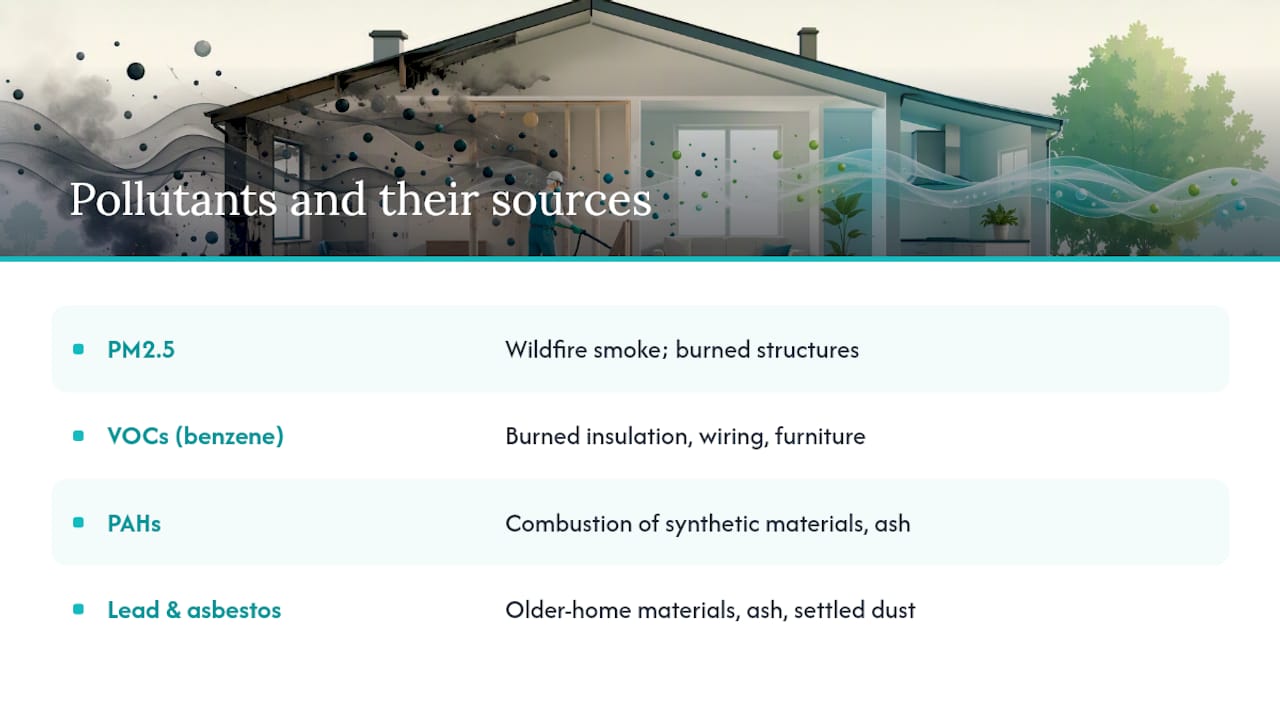
Children, pregnant people, older adults, and anyone with asthma, COPD, or heart disease face the sharpest risk. The World Health Organization identifies particulate matter as the primary public health threat from wildfire smoke and stresses that even low-level exposure carries risk for these groups. Watch for coughing, wheezing, chest tightness, headaches, or unusual fatigue in the days after exposure.
Cleaning up safely without spreading contamination
Cleanup done wrong can expose you to more ash than the fire itself did. Here’s the sequence that actually limits harm:
- Gear up first. Wear a NIOSH-certified N95 respirator, not a cloth mask, plus gloves and long sleeves before touching anything.
- Decontaminate at the door. Remove shoes and outer clothing before re-entering clean areas of the home.
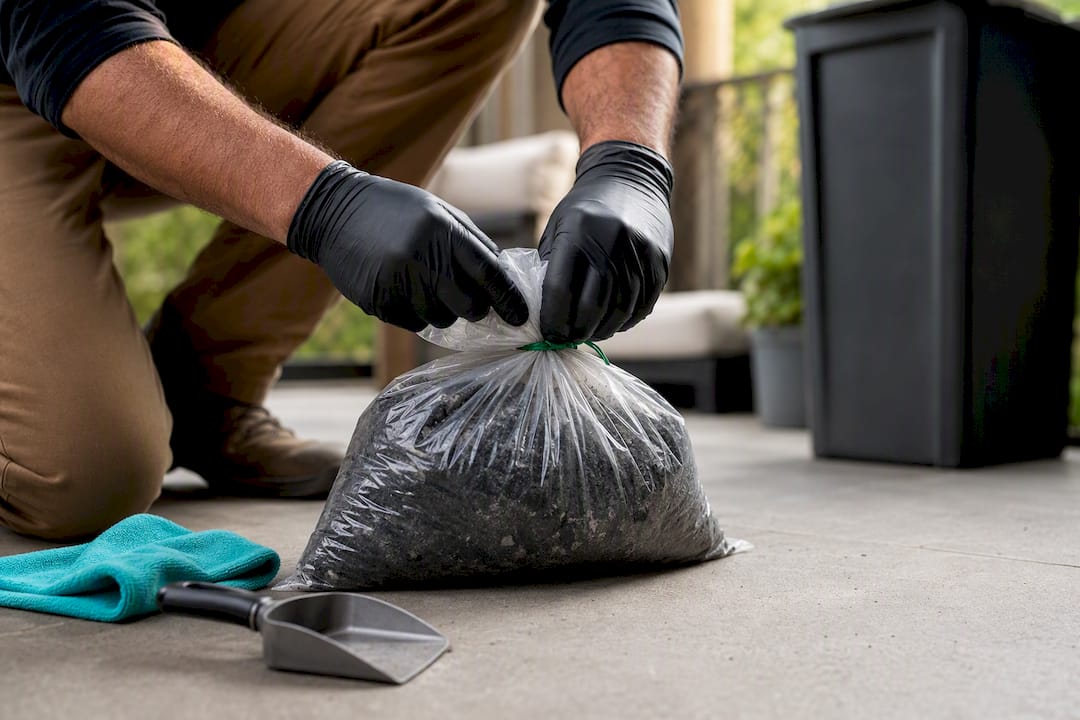
- Mist before you move anything. Lightly dampen ash with water to keep it from becoming airborne.
- Vacuum with HEPA only. A standard vacuum just recirculates fine particles back into the air.
- Wet-wipe hard surfaces after vacuuming to pick up what’s left behind.
- Launder exposed clothing separately from your regular wash to avoid cross-contaminating other fabrics.
- Handle pets carefully since fur traps ash and VOC residue that can transfer straight to your hands and furniture.
Children, pregnant people, and anyone with respiratory or cardiac conditions shouldn’t do this cleanup themselves, even with a respirator on. Have someone else handle it, or bring in a smoke damage cleanup crew if no one else in the household can safely take it on.
Pro Tip: Never dry-sweep ash or use a power washer on ash-covered exterior surfaces. Both actions launch fine particles right back into the air you’re trying to clean.
The EPA specifically warns against dry sweeping for exactly this reason, and the same logic applies to bagging ash for disposal: seal it in plastic before it goes in an outdoor trash can, not a loose pile.
Getting your HVAC and filtration right after a fire
Your HVAC system is either helping or actively working against you here. Running the fan continuously recirculates indoor air through your filter, which the EPA notes measurably reduces particle concentrations, but a standard filter alone won’t handle heavy smoke load.
- Upgrade to the highest MERV rating your system supports, ideally MERV 11 or higher, and swap filters more frequently than usual since they’ll clog faster.
- Add a portable HEPA air cleaner sized to your room using its CADR rating, and run it continuously as long as smoke risk persists.
- Choose a unit with activated carbon if lingering odors or VOCs are a concern, since HEPA alone doesn’t capture gases.
- Call for duct cleaning or HVAC service if you see visible soot inside vents or the smell keeps returning after cleaning.
Portable cleaners aren’t optional extras when particle counts are high. They’re doing work your HVAC filter physically can’t.
When DIY cleanup isn’t enough
Some situations call for more than a mop and a HEPA vacuum. Watch for these signals:
- Heavy ash coating interior surfaces, not just a light dusting
- Visible structural damage from the fire itself
- A smoky or chemical odor that persists after thorough cleaning
- Children, older adults, or anyone with respiratory disease living in the home
- An insurance claim that requires documented proof of damage and remediation
Professional testing goes well beyond what a consumer sensor can tell you. Targeted air and surface sampling, followed by lab analysis such as EPA TO-15 for VOCs, gives you an actual concentration reading rather than a rough estimate. The EPA notes that consumer-grade VOC sensors often lack the specificity needed for real risk assessment, which is exactly why lab-based testing exists.
This is where Infinity Restoration’s fire damage restoration process fits in. The team provides 24/7 emergency response, and because fire damage often comes with water intrusion from suppression efforts, having a Florida Licensed Mold Assessor on staff and advanced moisture mapping tools matters more than most homeowners expect. Real-time documentation throughout the process also gives you the paper trail insurance adjusters actually want to see.
How long contaminants linger and how to know you’re in the clear
Recovery timelines vary a lot depending on what burned and how close you were to it. VOCs from synthetic materials typically fade within days to about five weeks. PM2.5 can linger for weeks to months if it’s settled into carpet fibers or HVAC ductwork. PAHs and heavy metals in ash are the slowest to clear, sometimes persisting for months without physical remediation.
| Contaminant | Typical persistence indoors |
|---|---|
| VOCs (benzene, formaldehyde) | Days to about 5 weeks |
| PM2.5 / soot | Weeks to months if embedded in fabric or ducts |
| PAHs | Weeks to months without cleanup |
| Heavy metals (lead, etc.) | Months without physical removal |
Your practical benchmark for re-occupancy: multiple nearby sensors reading green or low for several consecutive days, no visible ash anywhere, and no lingering smoke smell. If your exposure was heavy, don’t rely on your nose alone. Get surface or air testing to confirm before you fully settle back in.
What most homeowners get wrong after a fire
The biggest mistake I see is assuming that once the smell fades, the air is fine. Odor and particle concentration aren’t the same thing, and PM2.5 embedded in carpet doesn’t announce itself. The second mistake is dry-sweeping ash because it feels faster, which just redistributes the exact particles you’re trying to remove.
The third, and most costly, is waiting to document damage before starting cleanup. Photograph everything first. My priority order is always the same: protect the people in the house, contain the spread, document what you see, then decide whether this is a DIY job or a call to a restoration crew.
— Nate
How Infinity Restoration helps you recover from fire damage
Infinity Restoration handles the parts of fire recovery that go beyond what a homeowner can safely manage alone: emergency response, coordinated air and surface testing, moisture mapping for water used in suppression, and mold assessment if dampness lingered. Every step gets documented in real time, which matters when you’re filing an insurance claim and need proof of what was damaged and what was done to fix it.
Call when you’re dealing with heavy interior ash, visible structural damage, vulnerable people in the household, or when you simply need testing to confirm the air is clear before you move back in fully. The team responds 24/7, and you can start with a look at Infinity Restoration’s fire damage restoration services to see what a full response includes and request an inspection.
For finished surfaces like doors and trim that survived the fire but need careful cleaning rather than replacement, these cleaning technique guidelines are a useful reference before you scrub anything with the wrong product.
Where to check air quality and get more guidance
Bookmark the AirNow Fire & Smoke Map for live regional readings, and review the EPA’s wildfire indoor air quality resources for cleanup specifics. The World Health Organization’s wildfire health guidance covers global risk context, while Colorado’s health department offers a practical cleanup checklist that applies regardless of where you live.
This article is general information, not a substitute for advice from a qualified doctor. Consult a qualified healthcare professional about your own circumstances before acting on anything here.
Sources
- Harvard T.H. Chan School of Public Health — Cardiorespiratory effects of wildfire smoke particles
- UCLA Newsroom — Air quality after the fires: Understanding where and when the air is safe
- EPA — Wildfires and indoor air quality (IAQ)
- Peer-reviewed review — Wildfire emissions, air quality, and health impacts