

Wind-driven rain damage happens when a storm’s wind forces water through an opening it created in your home, like a torn shingle or cracked window seal, rather than water rising up from the ground. Insurers typically cover it under your homeowners policy, but only if you can show wind caused the breach first. Photograph everything immediately, tarp or board the opening to stop further intrusion, and notify your insurer in writing before the water damage spreads.
TL;DR:
- Insurers typically require documented evidence linking windstorm, structural opening, and water intrusion to approve wind-driven rain claims.
- Moisture mapping, thermal imaging, and licensed mold assessments significantly strengthen the claim’s causation evidence.
- Proper documentation of temporary repairs, weather data, and interior damage within 48 hours is crucial for claim validity.
- Pre-storm home maintenance, such as inspecting and sealing roof and window flashing, reduces vulnerability to wind-driven water damage.
- Most wind-driven rain claims involve a three-phase process: emergency mitigation, adjuster inspection within 1-2 weeks, and repair completion often taking 6-10 weeks.
Table of Contents
- Wind-Driven Rain Damage vs. Flood: Why the Difference Decides Your Claim
- How Wind Rips Open a Building’s Defenses
- How Insurers Decide If Your Claim Is Really About Wind
- Building Your Wind-Driven Rain Insurance Claim: A Step-by-Step Evidence Checklist
- Storm-Proofing Your Home Before the Next System Rolls In
- Claim Traps That Cost Homeowners Coverage
- What Professional Storm Documentation Looks Like in the First 24 Hours
- How Long a Wind-Driven Rain Claim Actually Takes
- What a Wind-Driven Rain Claim Costs Once Everything Is Added Up
- Handling the Adjuster Without Losing Ground on Your Claim
- What the Research Actually Tells Us About These Claims
- Get Professional Documentation Before You Talk to Your Insurer Again
- Sources
Wind-Driven Rain Damage vs. Flood: Why the Difference Decides Your Claim
Wind-driven rain is water that wind physically pushes through a gap in your building envelope: a lifted shingle, a gap around a window frame, a damaged vent. Floodwater works differently. It rises from the ground, from storm surge, or from an overflowing waterway, and it enters low points regardless of wind. That distinction is why standard homeowners insurance typically excludes flood while covering wind-driven rain under the windstorm peril, when the wind itself created the opening.
The practical problem: hurricanes and tropical storms often produce both perils in the same event. Storm surge floods the first floor while wind simultaneously rips flashing off the roof, and now you have two different causes of water damage under two different types of coverage.
- Wind-driven rain through a roof breach: usually a homeowners or windstorm claim
- Rising water from surge or ground saturation: a flood claim, typically through NFIP or a private flood policy
- Both occurring together: expect to file with two insurers and separate the damage by cause
How Wind Rips Open a Building’s Defenses
Roofs take the first hit. Wind lifts shingle edges, tears flashing loose around chimneys and skylights, and pries at ridge caps until a gap opens. Once that gap exists, rain doesn’t need much wind speed to keep exploiting it. Windows and doors are the next weak points, and this surprises a lot of homeowners: rated windows and doors can still leak during extreme wind-driven rain even when they meet code, because installation quality and flashing detail matter as much as the product’s rating.
- Roof shingles, ridge caps, and flashing around penetrations
- Skylights and their seal perimeters
- Window and door frames, especially where flashing was skipped or aged out
- Soffits, attic vents, and gable vents
Once water gets behind a wall or into an attic, the visible damage is rarely the whole story. A hygrothermal study on building envelopes found that sustained wind-driven rain exposure drives moisture loads that cause mold, wood decay, and corrosion, while also degrading insulation’s thermal performance over time. A quarter-sized roof breach can soak insulation across an entire attic bay before anyone notices a stain on the ceiling below.
How Insurers Decide If Your Claim Is Really About Wind
Adjusters and courts lean on a concept called proximate cause, and in wind-driven rain claims it usually comes down to a three-link chain: windstorm, then a structural opening, then water intrusion. Break that chain, and the claim gets denied. Property insurance attorneys note that wind-driven rain is often used as adjuster shorthand for exactly this dispute: was the opening new, or was it already there?
Insurers commonly push back with a handful of predictable defenses:
- Pre-existing damage. They argue the shingles were already loose or the flashing was already failing before the storm.
- Maintenance exclusion. Many policies exclude damage from wear and neglect, so an aging roof becomes an easy target.
- Reclassification as flood. If water pooled at ground level anywhere near the loss, some adjusters try to shift blame to flood exclusions.
You counter each of these with a timeline. Weather data showing wind speeds at your address during the loss window, dated photos from before the storm if you have them, and a contractor’s written opinion on when the opening occurred all work together to rebuild the causal chain the insurer is trying to break.
Building Your Wind-Driven Rain Insurance Claim: A Step-by-Step Evidence Checklist
Insurers don’t take your word for it. They take your documentation. Build the file in this order, starting the moment it’s safe to move around your property:
- Photograph and video everything before touching anything. Get the exterior opening, the interior damage path, and any debris (shingle pieces, tree limbs) that show what the wind actually did.
- Shoot the attic and roof deck if you can safely access them. Water stains, saturated insulation, and daylight showing through gaps are strong visual proof.
- Bring in moisture mapping and thermal imaging. These technical readings document how far water traveled behind walls and under flooring, which photos alone can’t show.
- Get a licensed mold assessor’s report if standing moisture has been present more than 24 to 48 hours. Mold growth timelines matter for both health and coverage disputes.
- Pull local weather data for the exact date and time. Wind speed records from the National Weather Service back up your claim that a windstorm actually occurred.
- Notify your insurer in writing, not just by phone. A written notice creates a timestamp and a paper trail.
- Preserve damaged materials. Don’t discard soaked drywall or carpet until the adjuster has seen them or given clearance.
Pro Tip: Keep every receipt for temporary repairs, from tarps to plywood to a rented dehumidifier. Insurers reimburse reasonable mitigation costs, but only if you can prove you spent the money.
Storm-Proofing Your Home Before the Next System Rolls In
Prevention is cheaper than any claim, and most of it comes down to maintenance you can schedule instead of scrambling for after a storm warning.
- Inspect shingles every spring and fall; replace any that are curling, cracked, or missing granules
- Re-seal and inspect flashing around chimneys, skylights, and roof penetrations annually
- Clear gutters and downspouts so water doesn’t back up under roof edges during heavy rain
- Confirm windows and doors are installed with proper flashing, not just caulk, since installation quality often matters more than the product’s official rating
- Check weep holes and drainage paths on window frames stay clear of paint and debris
- Consider proper door weatherstripping and threshold sealing as part of your seasonal routine, since doors are an underrated entry point for wind-driven water
If your property sits in a coastal zone or has taken repeated wind-driven rain losses, impact-rated windows and upgraded flashing systems pay for themselves faster than you’d expect, both in reduced damage and in fewer disputed claims.
Claim Traps That Cost Homeowners Coverage
What you say and do in the first 48 hours can undercut a claim that should otherwise be solid. Avoid a few specific mistakes:
- Don’t tell an adjuster the roof “has been leaking for a while” if you mean a minor, unrelated issue. That phrase alone invites a pre-existing damage denial.
- Don’t cover the opening with only a tarp or plastic sheeting and call it done. Courts have inconsistently ruled that a temporary tarp doesn’t count as a “roof” for wind-driven rain coverage purposes, which can hurt you if repairs were already underway before the storm.
- Don’t skip photographing the temporary repair itself. Document the tarp, the boarded window, and the date it went up.
- Don’t wait on mold. Bring in a licensed assessor and a public adjuster or attorney if the insurer disputes causation or scope.
What Professional Storm Documentation Looks Like in the First 24 Hours
A trained restoration crew works through storm damage in a specific sequence, and that sequence is what makes the difference between a smooth claim and a drawn-out fight. Infinityrestoration’s field teams secure the property first, then document every opening and damage path before any cleanup begins, then move to moisture mapping across affected walls, floors, and attic spaces, and finally produce a scope report that ties the damage back to the storm.
That order matters because a licensed mold assessor’s report and moisture readings carry more weight with adjusters than homeowner photos alone. Insight from hygrothermal research backs this up: objective, instrument based readings create causation evidence that’s harder to dispute than a phone photo.
| First 24 hours | Why it matters for your claim |
|---|---|
| Secure and document the opening | Establishes when and how wind created the breach |
| Moisture mapping across affected areas | Shows full extent of intrusion, not just visible damage |
| Licensed mold assessment if moisture persists | Provides objective evidence adjusters and courts accept |
| Written scope report | Ties repair costs directly to the storm event |
Reviewing a storm damage checklist before a system even threatens your area gives you a head start on this process.
How Long a Wind-Driven Rain Claim Actually Takes
Most straightforward wind-driven rain claims move through four rough phases, and knowing the pacing helps you spot when something is stalling. The first 24 to 72 hours are about notification and emergency mitigation: you report the loss, make temporary repairs, and the insurer typically assigns an adjuster within a few days.
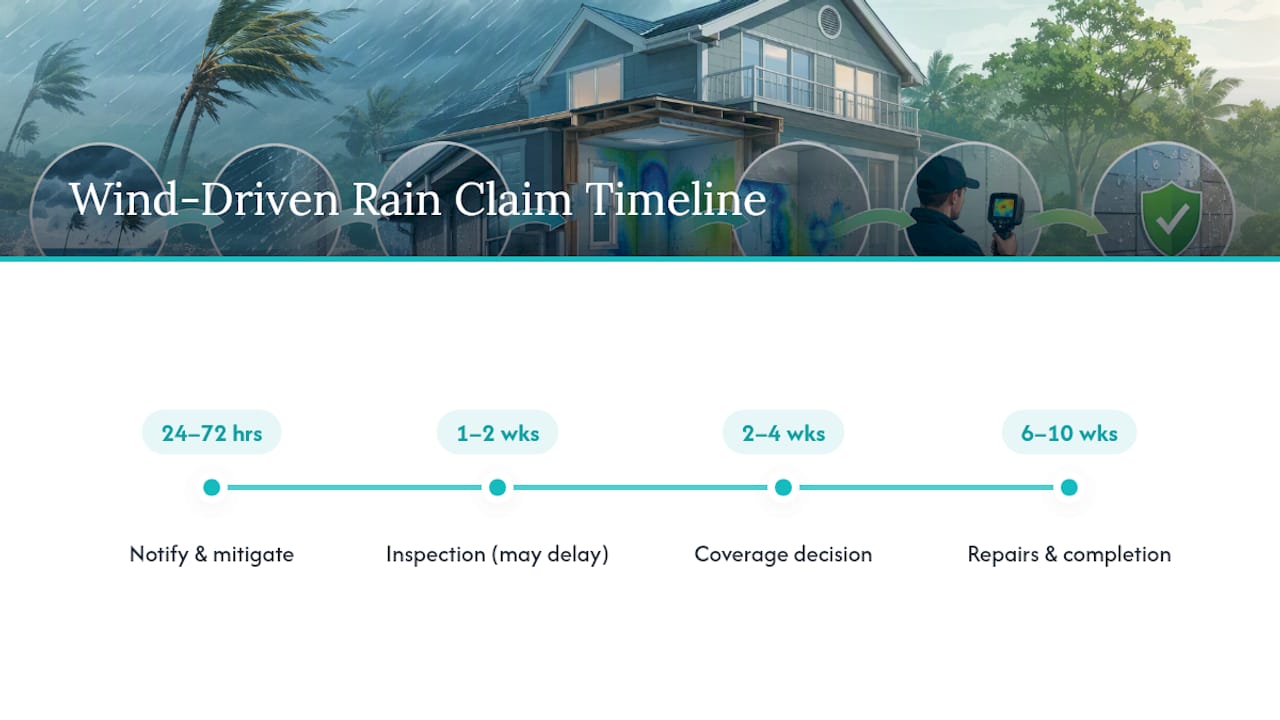
The inspection phase usually happens within one to two weeks of filing, assuming the storm wasn’t a major regional event that overwhelmed adjuster availability. During a widespread hurricane, that window can stretch to four to six weeks simply because every insurer in the region is juggling thousands of claims at once. This is where your own documentation, timestamped photos, moisture readings, and a written scope report, starts paying off, because it lets an adjuster verify your loss faster even if they can’t get to your property immediately.
Once the adjuster completes their inspection, expect a coverage decision and initial payment estimate within two to four weeks for undisputed claims. Disputed claims, especially ones where the insurer suspects pre-existing damage or wants to reclassify part of the loss as flood, can drag into several months of negotiation, supplemental claims, and sometimes appraisal or litigation.
Full repair completion depends on contractor availability and material lead times as much as the insurance timeline itself. A roof and interior repair after a moderate wind-driven rain loss often runs six to ten weeks from the first adjuster visit to final walkthrough, longer if the storm caused regional demand spikes for contractors and materials.
What a Wind-Driven Rain Claim Costs Once Everything Is Added Up
Your out-of-pocket exposure starts with your deductible, and hurricane or windstorm deductibles are often calculated as a percentage of your home’s insured value rather than a flat dollar figure. The exact percentage varies depending on your policy and state, but these deductibles can be substantial before the insurer pays a dime.
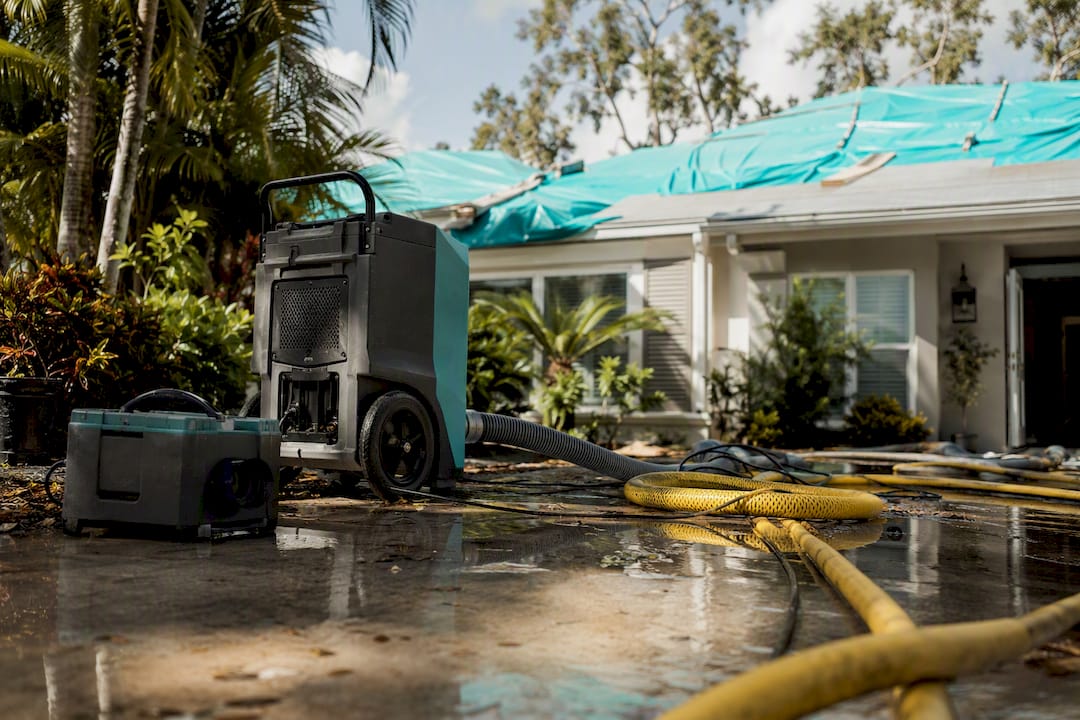
Beyond the deductible, homeowners typically face a few recurring cost categories. Temporary mitigation, tarping, board-up, water extraction, and dehumidifier rental, can run several hundred to a few thousand dollars depending on the scope, and insurers generally reimburse these costs as part of the claim if documented with receipts. Roof repair or replacement varies enormously by size and material, but a full asphalt shingle roof replacement on an average home commonly falls in the five figures. Interior repairs (drywall, flooring, insulation, and mold remediation if moisture sat too long) add another layer of cost that’s highly dependent on how far the water traveled before it was caught.
The Insurance Information Institute’s hurricane season guidance recommends reviewing your deductible structure and coverage limits before storm season starts, precisely because these percentage-based deductibles catch homeowners off guard when they assume their deductible works like a standard flat homeowners deductible.
Handling the Adjuster Without Losing Ground on Your Claim
The adjuster works for the insurance company, not for you, and keeping that fact in mind shapes how you should approach every conversation. That doesn’t mean adjusters are adversarial by default. Most are simply following a process, but it’s a process designed to verify and often minimize the payout.
Ask direct questions early: What specific evidence are you using to determine cause of loss? Is any portion of this claim being classified as flood or pre-existing damage? What’s the timeline for your coverage decision? Get answers in writing when possible, even if it’s just a follow-up email summarizing a phone call.
Watch for a few red flags that suggest a claim is heading toward a dispute. If an adjuster repeatedly asks about the age of your roof without asking about the storm’s wind speeds, they may be building a pre-existing damage argument. If they mention flood exclusions before you’ve said anything about ground-level water, they may be trying to reclassify part of your loss. If the settlement offer arrives without a written scope of damage, request one before accepting anything, since a scope report is what lets you or a contractor verify the numbers add up.
Bringing your own documentation, weather data, moisture mapping results, and a contractor’s independent estimate, into these conversations shifts the dynamic. You’re no longer just responding to their assessment; you’re presenting a competing one they have to address.
What the Research Actually Tells Us About These Claims
The conventional advice on wind-driven rain claims focuses almost entirely on what to photograph. That’s necessary, but it undersells the real fight, which is causal. Insurers aren’t usually disputing that damage exists. They’re disputing when the opening formed and what caused it, and that’s a technical argument homeowner photos alone rarely win.
What actually moves these claims is objective, third-party evidence: moisture readings that map how far water traveled, weather data that times the storm against your damage, and a licensed professional’s written opinion tying the two together. Homeowners who skip that step and rely on smartphone photos and memory are negotiating from a weaker position than they realize, even when their claim is legitimate.
Prioritize the causal chain first, then the cost estimate. An insurer that can’t dispute how the opening formed has far less room to argue about how much repair should cost.
— Nate
Get Professional Documentation Before You Talk to Your Insurer Again
If you’re staring at a wet ceiling and a claims adjuster who keeps asking about your roof’s age, you need evidence, not another opinion. Infinityrestoration brings 24/7 emergency response, advanced moisture mapping, and a Florida Licensed Mold Assessor to Orlando-area homes and businesses dealing with wind-driven rain intrusion, which means your claim file gets built with the kind of technical documentation adjusters have a harder time dismissing.

This isn’t a general handyman fix. It’s a team that secures your property, maps the moisture path room by room, and hands you a written scope report designed to survive an adjuster’s scrutiny, all while keeping repairs compliant with local safety codes. If water has already made it past your roof or windows, request emergency water damage restoration service now, before the moisture spreads further and the documentation window closes.
Sources
- Storm-Driven Rain Penetration of Windows, Skylights and Doors White Paper (FGIA/AAMA)
- FEMA/NFIP: Wind vs floodwater damage fact sheet (Agents.FloodSmart)
- Wind-Driven Rain Trap (Property Insurance Coverage Law blog)
- Wind-driven rain impacts on building envelopes (Build Environment, 2024)