

If your water bill jumped without explanation, your meter keeps moving with every faucet off, you hear running water when nothing’s on, or one patch of floor feels warm for no reason, you likely have a slab leak. The single next move is the water-meter test. Any two of these signs together mean stop waiting and confirm it today.
TL;DR:
- A water meter test with all fixtures off confirms a slab leak if the meter’s low-flow indicator keeps moving for 10-15 minutes, especially at night.
- Warm spots on flooring and damp or warped materials suggest hot water leaks or prolonged moisture exposure, often indicating a leak has been ongoing for weeks.
- Detecting leaks involves isolating hot and cold lines, with thermal imaging useful for hot leaks and acoustic tools for cold or hidden leaks, both requiring professional use.
- Structural signs like cracks or efflorescence generally indicate long-term water intrusion, and early detection relies on careful monitoring of water bills and meter readings.
- Immediate water shutoff, documentation, and professional moisture mapping are crucial after confirming a leak to prevent mold growth and extensive structural damage.
Table of Contents
- Top Signs of a Slab Leak Homeowners Actually Notice
- How to Confirm a Suspected Slab Leak Yourself
- What to Do Next After Confirming a Leak
- Why Moisture Mapping Changes What Happens After a Leak Is Confirmed
- An Editorial Take on Slab Leak Detection
- Getting Help After a Confirmed Leak
- Sources
Top Signs of a Slab Leak Homeowners Actually Notice
Slab leaks hide by nature. The pipe runs under a concrete foundation, so there’s no visible drip to point you to the problem. What you get instead are secondhand clues: a bill that doesn’t add up, a sound that shouldn’t be there, a warm patch on tile that used to be cool. Each sign below carries a different level of reliability, and knowing which ones to trust saves you from tearing up flooring over a leaky sprinkler head.
1. Unexplained spike in your water bill
A noticeable increase between billing cycles, with no new appliances, guests, or irrigation changes, is one of the more dependable red flags. Utility companies flag slab leak signs this way constantly, because a pressurized supply line under a slab doesn’t stop pushing water just because nobody’s home. Pull your last four or five bills and look for a step change rather than a gradual climb. A gradual rise usually points to a bigger household habit shift. A sudden jump points to a leak.
2. Water meter movement with everything off
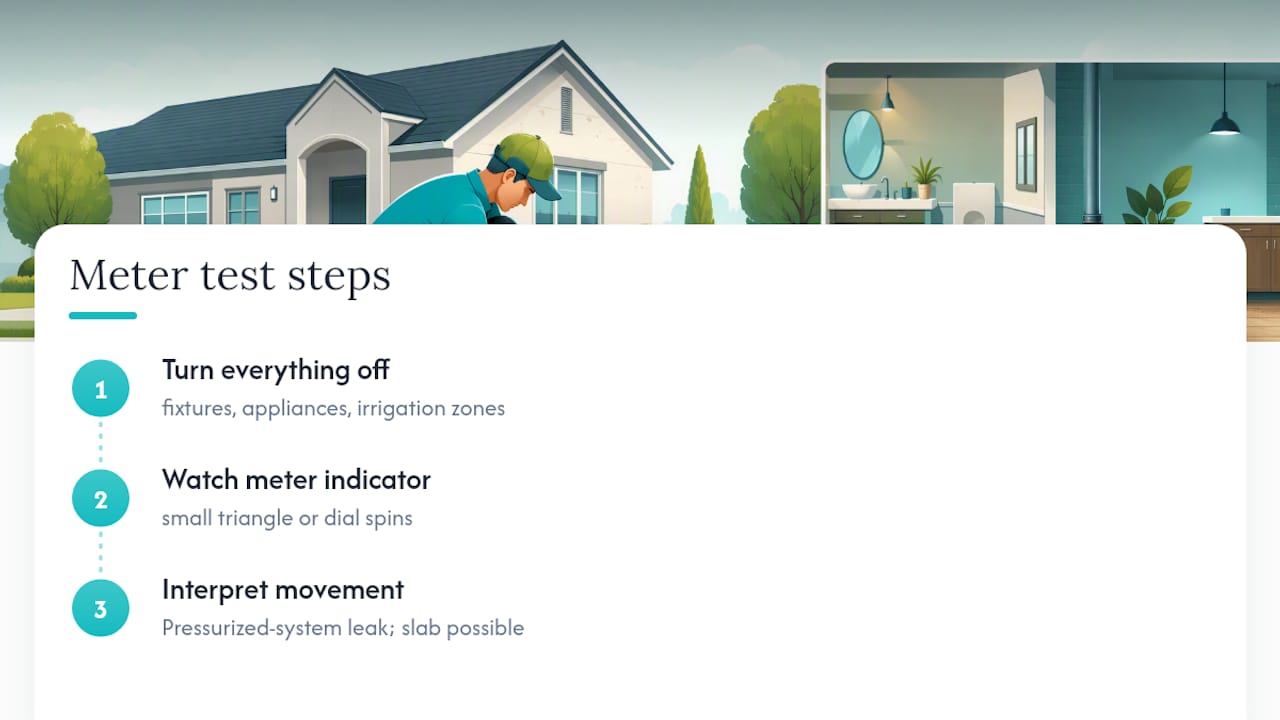
This is the test that actually confirms rather than just suggests. Shut off every fixture, appliance, and irrigation zone in the house, then watch your meter’s low-flow indicator, a small triangle or dial that spins with even minor flow. If it’s moving with nothing running, water is escaping somewhere in the pressurized system, and a slab leak is one of the top suspects.
3. The sound of running water in a quiet house
Homeowners describe it as a hiss, a faint gurgle, or a sound like a toilet that won’t stop filling, audible mostly at night or when the house is otherwise silent. It’s not proof on its own, since old fill valves and water softeners can mimic it, but paired with a meter that’s moving, it’s a strong secondary confirmation. Walk the house room by room and note where the sound gets louder. That gives a plumber a head start before any equipment comes out.
4. Warm or hot spots on the floor
If your slab leak is on the hot water line, the escaping water often heats the surrounding concrete and flooring, creating a patch that measures roughly 5 to 10 degrees Fahrenheit warmer than the surrounding surface. Check barefoot early in the morning before the sun has warmed the floors and before the HVAC system has cycled much, since both can create false warm zones. Tile and stone floors show this most clearly; carpet muffles it.
5. Damp carpets, warped wood, or puddling with no clear cause
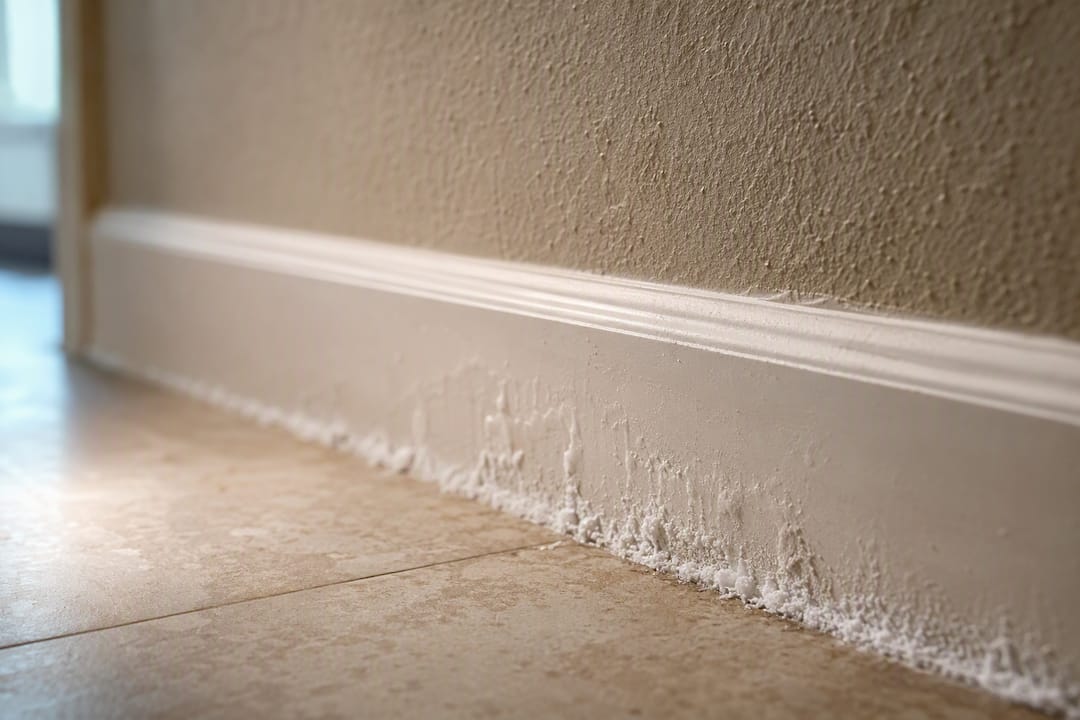
Water finding its way up through a hairline crack in the slab will show up as a damp carpet edge, cupped or warped hardwood, or a puddle near a wall with no plumbing fixture nearby. Look for a white, chalky mineral deposit at the base of walls or slab edges too. It’s called efflorescence, and it forms when water carrying dissolved minerals evaporates at the surface, leaving the minerals behind. It’s a sign moisture has been present for a while, not just today.
6. Low water pressure across the entire house
One weak shower usually means a clogged aerator or a fixture problem. Weak pressure at every tap, every shower, and every hose bib at the same time means water is escaping the system before it reaches your fixtures, and a slab leak is a common culprit. The distinction matters: isolate the problem to a single fixture and you’re chasing something small. Isolate it to the whole house and you’re chasing something under the floor.
7. Musty odors and mold near baseboards
A persistent musty smell near baseboards, especially in a room with no obvious water source, often means moisture has been wicking up into drywall and flooring for weeks. By the time mold becomes visible, the moisture has usually been present long enough to affect more than just the surface. This is one of the later-stage signs, meaning the leak has probably been running for a while already.
8. New cracks in tile, flooring, or interior walls
Cracks are the most advanced and most misread sign on this list. A hairline crack in a single tile grout line is often just seasonal settling. Stair-step cracks running through drywall near a corner, or a crack that’s widening month over month, suggests the slab itself is shifting, possibly because water eroding the soil beneath it is compromising its support. That’s a structural signal, not a cosmetic one, and it usually means the leak has been active for some time.
Pro Tip: Before you trust any meter reading, walk outside and confirm every irrigation zone is fully off, including the controller. Automatic sprinkler systems are the single most common cause of a false-positive meter test, and if your system runs on a timer, repeat the test at night when you know it won’t kick on.
A few things mimic slab leak symptoms without being one. A water heater’s temperature and pressure relief valve can weep small amounts of water onto the floor nearby, which looks like a leak but isn’t a slab issue. Chilled floors from a cooling system’s ductwork running underneath can feel oddly cool in a way that gets misread as a warm-spot leak by comparison. And irrigation lines running close to a foundation can dampen soil enough to show up as a damp interior wall base. Rule these out before assuming the worst.
How to Confirm a Suspected Slab Leak Yourself
Signs get you suspicious. Tests get you certain. Here’s the order that actually works, cheapest and easiest first.
- Run the water-meter test properly. Turn off every fixture, appliance, and irrigation zone, then find your meter’s low-flow indicator, usually a small triangular dial. Watch it for a full 10 to 15 minutes. If it’s spinning with nothing running anywhere on the property, you have confirmed water loss. Repeat the test at night if your irrigation runs on an automatic timer you might have missed.
- Isolate hot versus cold at the water heater. Shut off the water heater’s inlet valve, then check whether the running-water sound or meter movement stops. If it does, the leak is on the hot side, which narrows your search dramatically and makes thermal imaging useful. If nothing changes, you’re dealing with a cold-side leak.
- Consider a basic pressure test, with limits. A pressure gauge threaded onto an outdoor spigot can show whether your system is holding static pressure over time. It’s a reasonable DIY step, but it won’t tell you where the leak is, only that one exists.
- Bring in thermal imaging for hot-side leaks. An infrared camera can spot the warm plume from a hot water leak straight through tile or hardwood, which is why professionals lean on it first when the water heater isolation test points to the hot line. It’s far less useful for cold-water leaks, which usually have no thermal signature at all.
- Know when acoustic listening and tracer gas take over. Cold-side leaks and any leak that thermal imaging can’t pin down require acoustic detection equipment or tracer gas, tools that listen for the specific sound signature of pressurized water escaping a pipe, or trace a harmless gas injected into the line. These require professional equipment and training. Combining the water-meter test with hot/cold isolation and, when needed, thermal or acoustic methods is the standard approach professionals use before anyone opens the slab, and it’s the same order the EPA recommends for catching household leaks early to limit wasted water.
If your meter test is negative but you’re still seeing warm spots or damp flooring, don’t assume you’re in the clear. Some leaks are intermittent, tied to water pressure cycles or specific fixture use. A negative meter test on one occasion isn’t the same as a clean bill of health.
What to Do Next After Confirming a Leak
Once the meter test or a professional inspection confirms water loss, speed matters more than perfection. Here’s the priority order:
- Shut off the main water supply immediately if you see any active flooding or standing water.
- If you’ve isolated the leak to the hot line, shut off the water heater entirely until a plumber arrives.
- Move furniture, rugs, and boxes off any damp flooring to limit staining and mold growth.
- Run a dehumidifier or box fan in the affected room to slow moisture buildup.
- Photograph every visible sign: warm spots, damp carpet, cracked tile, meter readings with timestamps.
- Pull your last six months of water bills together; insurers and plumbers both want this timeline.
For the repair itself, a licensed plumber typically handles straightforward spot repairs. If the damage has spread to flooring, drywall, or you’re dealing with standing water, an emergency restoration company needs to be part of the call, often on the same day. Expect a plumber to either patch the specific section of pipe, reroute the line above the slab, or in cases of repeated pinhole leaks from aging or corrosive pipe, recommend a full repipe rather than chasing the same problem twice.
Pro Tip: Keep a simple folder, digital or paper, with your meter readings, timestamped photos, and copies of your water bills from the start of the suspected leak. Insurance adjusters move faster when the timeline is already documented instead of reconstructed after the fact.
Why Moisture Mapping Changes What Happens After a Leak Is Confirmed
Finding the leak is only half the problem. What that water did to the structure around it while it was running unnoticed is the part homeowners underestimate. Infinityrestoration uses advanced moisture mapping to read moisture levels inside walls, subfloor, and insulation that look completely dry on the surface, because a slab leak rarely stays contained to the spot where it surfaces.
Visible dampness on a floor is often just the tip of what’s actually saturated underneath. Moisture mapping tells us how far the water traveled, which materials absorbed it, and how urgently drying needs to start, information a visual walkthrough alone can’t give you.
Fast water extraction and structural drying in the days right after a confirmed leak are what actually prevent the mold growth and swelling wood that turn a plumbing repair into a full room rebuild. When cracked tile, warped subfloor, or a musty smell has already set in by the time you call, that’s usually the signal you need restoration work, not just a pipe repair. Hidden water damage in walls behaves the same way slab leaks do: the damage you can see is rarely the whole story.
An Editorial Take on Slab Leak Detection
Most advice on this topic jumps straight to scary language about foundations crumbling, then pivots to selling a service call. That’s backwards. The research is clear that a $0 water-meter test, run correctly, catches the majority of active leaks before you spend a dime on equipment. The conventional advice underrates how many false positives come from irrigation systems left running, and overrates how often homeowners actually need thermal cameras or acoustic gear on day one.
Here’s what I’d prioritize differently: confirm before you diagnose location. Too many homeowners skip the meter test, panic at a warm floor patch, and call for expensive detection work before ruling out the cheap explanations. Do the meter test first. Isolate hot and cold second. Only bring in acoustic or tracer-gas tools when those two steps point to a real, located problem.
Where I’ll defend the paid-service side: once water has been sitting under your flooring for weeks, DIY confidence should end. That’s a drying and structural question, not a plumbing one.
— Nate
Getting Help After a Confirmed Leak
If you’ve run the meter test, isolated hot from cold, and confirmed water is escaping somewhere under your slab, the plumbing repair is only step one. What that water did to your subfloor, drywall, and insulation while it went undetected is the part that determines whether you’re looking at a simple dry-out or a larger rebuild.

A local restoration company runs 24/7 emergency response specifically for situations like this, where a confirmed leak has already caused visible dampness, warping, or that musty smell that signals moisture has been sitting for a while. Advanced moisture mapping can pick up saturation inside walls and subfloor that a visual check misses entirely, which matters because insurance adjusters want documented proof of exactly how far the water traveled, not just where it surfaced. A licensed mold assessor may be part of that process too, so if mold has already started, testing and remediation can happen under the same visit instead of a separate referral.
The first call typically covers a quick description of what you’ve found, meter readings if you have them, and how long the signs have been present, then a technician schedules onsite triage to start extraction and drying before damage spreads further. If you’re dealing with active water damage right now, Infinity Restoration’s emergency water damage service is the place to start.
Sources
- Pinpoint the Slab Leak Before You Break the Floor | Contractor Magazine
- Water Leak Under Concrete Symptoms: Top Signs of a Slab Leak — LeakTronics
- Fix a Leak Week | EPA WaterSense